


入群后可获得权益
①免费使用类GPT功能
②参与群任务,领取麦粒等奖励
③收获指南、会议、文章等资源
④群成员交流互助
扫码加群主,邀请您入群

医生加群二维码

e脉播公众号二维码
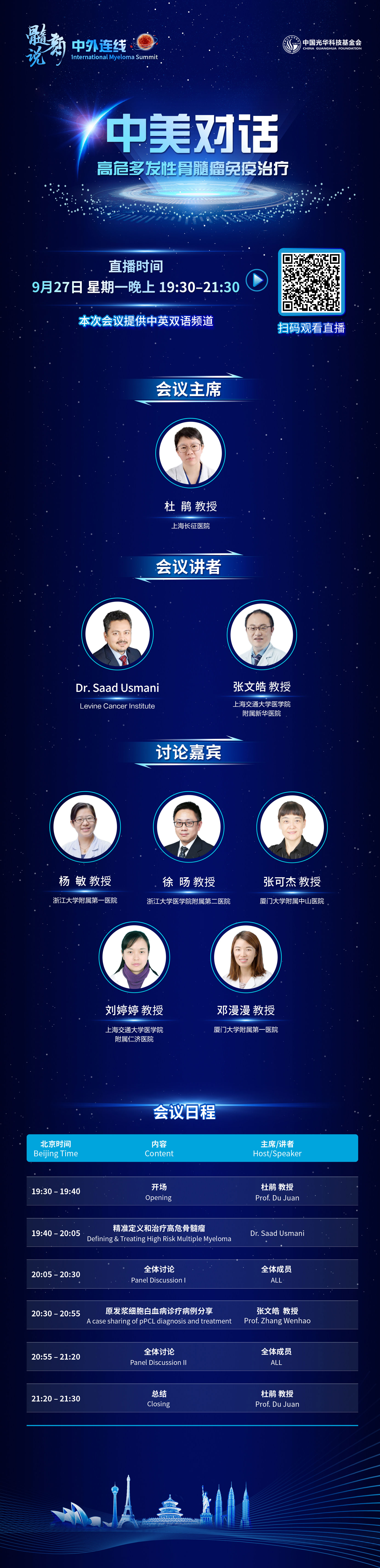
回放 英文频道丨髓新说-中外连线:中美对话-高危多发性骨髓瘤免疫治疗

微信扫码
点击赠送








直播时间
2021年09月27日 19:30--21:30(UTC+8)
直播简介
直播时间:2021年9月27日 19:30-21:30
直播主题:髓新说-中外连线:中美对话-高危多发性骨髓瘤免疫治疗
 加载中...
however,呃,still some patients experience a long religion, but it呃。
progression is still very poor, especially for high risk patients。
so the uh procognotic factor has also changed the due to the technology advance to provided new data and the partly because some of the lower drugs have already change the disease course。
so the question is。
who are the real high risk, much by minimum patients in today and how to improve a high risk patients and how to define uh and how to treat the high rik patience。
so i think this is a very hot topic and a very big challenge for us, especially further patients。
嗯,today, i think we have the two topics in this seven, the the one the doctor was money will focus on definition and and the treatment high risk, another one from the doctor jhwill share a clinic practice for us。
ok, i think maybe let's go to the first session。
uh, a and also doctor was money。
do you want to say something? i say holo to the chinese colleaguirls。
it's it's been a, yeah, it's a privilege to be joining you virtually, um you know, i hope that。
uh, once the pdedemiis over we can meet in person, this is a very important topic, and um there's a lot of focus now being um being given to identifying high risk patients and perhaps doing clinical trial specifically for harrish patients。
so i appreciate the opportunity to speak to all of you and for jhnson to sponsoring this program。
ok, thank you。
ok, i think let's move to the first session。
i'm very honored to introduce the doctorves money。
嗯,i think a lot of the chinese colleague will be very foriliating, because doctor is our good and old friends, and he from living casase intitude, and he is the chief from from the recherreresearch。
also, we know doctors money。
uh joa。
a lot of the membership, such us MWG swag, ash, and so on。
uh, he is as the PI for more than forty five clinic, two, five, three and published the hundred a high quality series such results。
he is a very distinguished and after standing himptologist specialist and a study dramatically proprompt, the development of madomoma field。
so today, let's give the big hand and warmly welcome the doctor's money to share the the topic。
please。
hello, everyone。
my name is sad。
this money, and i'm going to be talking to you about defining and treating high risk multiple my uloma。
in the context of what we understand about the disease biology as well as some of the newer tritreatments that are um in development and an recent data that has been shared at different congresses。
these are my disclosures。
what is important to appreciate about my looma is that it's not one disease。
it's highly likely that the way that we characterize my loma will change in the future because。
嗯,哦。
how different um diseases exist under that umbrella of multiple millooma?。
嗯。
we now understand that amguas is the precurercier condition that leads to active miluloma, and that transition period is different amonts different patients depending on disease biology。
the diagnosis is made at variable timepoints during this。
journey from angguas to active my laoma so patience。
they present to us with different invogant damage。
and that's what makes the disease interesting with a lot of newer treatments。
miloma is becoming more like a chronic killlness, a majority of patients, but the highest disease remains a big challenge。
i think with the million lion world, so i will being somewhere around。
five five and half years now that's still better than what it used to be say a decade and a half ago。
but you know, we have now started to understand my loma biology better。
that has led to new therappeutic targets。
and then there are newer treatments, focusing now or newer ways in which we are trying to。
um manipulate the bonment of my environment, utilize the indian system um modulated。
to um to influence the disease natural history。
if we look at our staging system, however。
the staging system is still kind of cruel because it does not gave us a very good sense。
or or the complete picture of diseased biology。
so the IS staging system, which was published in two thousand and five and the revised ISS, which tried to incorporate some highest beaches。
um and was published about six years ago, they do an incomplete job。
so the ISS staging system relied on。
see them argument in beata to microcluloppling values。
um and threvised diasasses included harrik fish features by just translocation for proteine and delicious seventeen p。
and eldioate levels, whether they are normal or high as the hydest features in, and that's sent incomplete way of looking at the picture, because the way that we define hydest disease is very different um today than than we did in the past。
we all recognize that extreme lady, my lauma。
and primary plassmaas allukimium are aggressive clinical panotypes。
and these patients do not do well。
we also recognize that math and math be over expression with translocation pourteen sixteen and pourteen twenty。
are high risk features than we are starting to appreciate that game and amplification of promose on want you to one。
um um you know, and over expression of several proprodudusm jeans。
um is canada, that is an important harghst feature than the deliciation seventeen eighty。
monoonly claws tends to be bad and by lilly, lalaws tends to be worse。
and then translocation poll forteen can be a mixed back。
you know, this can behave。
as good as immediate or even standard risk can some patients, especially if you using prode use so many bitters。
but then um it can be uh ririk in other scenos。
then poorest by ge exprespression profiling。
and then having certain gene mutations, which end up being more of late events。
the other important thing is you ah we don't do a good assessment of um miluoma disease biology didiagnosis relalapse。
because。
uh, we are highly dependent on the quality of the depel with bonbibiopsy。
we can create a stairs know as so p for for sample packing order um to do that, but then not all patients are getting in pet cities at the time of uh original diagnosis to look at in other focal bond lesions are extremeally in my lama。
and and we are not using disease biology parameters cannot bhapsing those um um legions um know know understand disease biology, gy。
then um we are looking at。
disease biology yet at。
finlike time point。
so it's hard。
那个是。
with you can do so many wive season pretious。
so so with these careers in mind, you know, when we when we see a patient who had cauten court, normal cycrogenetics, and they're progressing very quickly after a initial therapy。
we get surprised or this is this patient is not responding well um h or is an unexpected earlier lapsed。
um when we see that。
you know, that's not a surprise because we we haven't understood the disease biology very well for that particular patient, and then we're still learning how to incorperate。
you know, the imminum status and bondmicron laid statatus miloma patienless susense, and also trying to optimize the best way of detecting depth um of response and mr。
t status。
so。
let's talk about some of the current strategies, and i'm going to take you back in time。
so before two thousand and ten, when the two new drugs that were introduced in the scheme of milanma treatment, in addition to conventional chemotherapy, where the little mide and and tism made, what we learned was botism had made an impact in translocation for fourteen disease。
my improving。
um overall survival compared to standard of caare arm。
the thredemid did not make that impact。
then for delicious seventeen p。
we learned that addition of botism improved, but does not overcome the survival um um um。
um at the course proprognosum attributed to delicious seventeen p。
but beyond that, there was not a lot lot proprogress。
in fact, if you look at the total therapy experience from arkansa, where protece some inevitaties and imminimal litatory drugs were incorporated。
into the induction transplant, consolidation, maintenance, schema。
the estimated million PFS of highest patients in both those protocols was about twenty six months。
so just highlighting the fact that the outcomes of these patients um gener was was not great。
in fact, overall survival uh for these patients in the medium。
was somewhere around three years or two half f three years, even after giving everything。
so for highest patients, um a front line protocol was。
was generated in um in in this fog milommasterstering committee。
this is the cooperate。
one of three corporate cooperative groups in the united states。
and um this was the first。
trial renandmized face to trial focused on highst patients。
so it started in two thousand twelve, the standard of karm was already for induction for eight cycles。
followed by maplants。
and at that time, a lutuism up was the anti body that was showing some activity um in combination with um landlitimied as well as botisen。
so it was added in the expemental arm。
um the private inpoint for the study was BFS。
and this study included hyest patients。
so you can see that this was the highest definition that was utilized。
um you had fish ernormalities, you had primary plasasmaster looking here, you had patients who arervated ccineameldia twice about the institutional appeal, the limit of normal。
he had genen expression profiling pool progranosis。
and then。
the study accrured very well。
and the study was read out last year and it published this year。
um so medium follow up fifty three months。
um ququite bbof follow no difference in PFS in the alv i arm。
the median PFS was thirteen monmons。
which was still better that the historic controlled ressain total therapy。
of twenty six months, same for the yellow tzo member。
and the medium OS。
had not been reached in the RB diar, but it had been reached in the RVD yellow tusen obama, sixty eight months。
so。
if you look at。
the various trials contemporary trials。
we find that the highest subset is small。
and the highdest definition is very different。
so effort is under way right now。
to try to come up with that combine hiyest definitional and share that with you when i talk about future strategies。
and then the amvery university um recently published their experience of about a thousand patients who have been treated with already。
and then for harghst patients um RBD was used as maintenance, and they show something similar the median OS for patients who um had revised ISS sttes three disease was about sixty months, and the median PFS for those patients was thirty one months。
so what about KR dy?。
in transplant eligible pations, where we we find that car fills them it in smaller subsets。
a small studies。
did show favorable results for hiirerst cadiotypical annormality patients。
this was the study that was published um by the university of chicago multiple minumal research uh consortion study。
um in which there was uh a group of hiero patients, twenty seven, higher sptienentretreated with the approach of kardias induction and post transplant k ardias consolidation folwered by KR is maintenance seven, the at a medium followup of over fifty months。
the sixty month BFS rate for highest patients was impressive fifty seven months。
um and the OS rate was seventy two percent。
um more importantly, the forty trial, which was published um or presented by a doctor franchise ka gaay。
looking at three arms。
uh renomied to either case ety as inductionand post transplant consolidation or KRD as post time uh as inductions and post transplrent consolidation or twile cycles of KRD。
and then there was a second rainomization to landworsus scaline as maintenance。
but with the first ronomization, what was seen is a clear benefit in terms of PFS in subrouananalyes for KRD。
followed by stem cell transflant, and that benefit appears to be similar。
for standard as well as higher spacious。
and then if we look at the PFS in the intentiory premaintenance patients for uh a mr。
i negativity that too uh favoured k ardy translant consolidation kardy aren't um both for standard as well as highless patients。
what about direr mooma?well, crooff is uh in each of these individual, nearly diagnostudies look at my a casasioppiia and else y on。
um in each of the studies, there was。
some benefit that was, you know they was um some uum benefit that was seen in a met analysis setting。
but in each of individual trials, the benefit was not very clear。
however。
you know, the rational that many of us utilize is trying to get better at the response, adding directoral movement with in a may benefit highest patients because we don't have a good answer。
so let's go for that strategy。
so with that in mind, um this is approach that we typically take for our patients who are higheighsts can transplant eligible。
we use either caardy for four cycles of conduction um or there are ready for four cycles of conduction, followed by stems, set, mobilization and transplant。
we may utilize consosolidation prepatitions who are not in ACR better and the patients around and imid the i mainance。
then for transplant eligible patients。
typically it's RVD light or DID as part of uh, the treatschechemi patients are getting already light。
after they've had a response se plaatu。
we have a those atannuated amid BI maan strategy for them。
but what about extremedinary meloma or plassmaa lickmiia there?。
we try to sight to reduce the patients quickly with。
uh BD pace, whether without pil or or plan and undermite um and this is done for younger patients for older patients。
we are using already, whether without there a two map。
um for transmant eligible patients uh after stantiel transplant, they remain on RVD as maintenance until relapps the progression。
whereas for tranlitting eligible patients, we try to maintain them on API emit maintenance strategy。
and then for younger patients, some younger patients, we think about reducintensity um hello as well。
and since these patients are at a high chance of having seen as involvement, we would look at CS of analysis for these patients and and may give IT chemotherapy。
and in absence of better than we are to inducction, the approach becomes that of a primary refragory patient。
and we try to switch to second line treatment and that, that is a very difficult clinical scenario。
let's take a look at emerging treatment strategies。
i'll share with you this clinical trial that we are doing here at the libinan constitute, which is aiming for a response adaptive strategy for all milomic patients。
trying to get patients to ARDI negative status。
and see how patients do after that。
um and then you know, MRD, if patients are MR dy positive, we modify the treatment scheme accordingly um and um。
and um um cannot give them subsequently and become depending on their transsmate eligibility or not。
what about cartiyseeltherapies what we're learning from the carara experience that this was?。
the face to pivotal face to karmastery that led to the approval of idsel。
um we see that in extra melarary disease in highest pytetic genetics。
the response to either cell appears to be somewhat similar。
呃,then to the groups that don't have those features。
however, you know, we need to see whether the durability of that response appears to be the same。
so we will have to。
waa bit longer。
what we do know is that the medium clear fess for those patients。
appears to be at least over nine months。
um so that's a good single。
um then。
for siltercent, which is the other cartisel therapy that's making its way through um clinical trials。
there's an ongoing cohhold front line cohohold um of nearly diagnosed mililoma patients with higherst disease have their defining gpaath s ice。
the states three。
patients are getting dra with VID for induction。
then they get their athrsis。
they continue dra VID as induction, followed by silter celdthen。
they can get DR as consolidation。
so this is an ongoing study。
then got my phall。
is uh a front line study where patients get induction followed by either cell。
and then um once they recovered patients may receive landmate。
and so this is an ongoing study evaluating。
BCMAR ty in the front line settings。
so we have new studies, but both eider cell as well as widsilled cell。
then there are concepts that are developing within the US cooperate group setting。
uh, this particular concept is uh for harrish patients who are transplant eligible receiving BCM materity i after stenell transplant and being grandommized to are be dare r or at EN engager。
and then the idea would be if patients are getting sustained MID at one year, you stop treatment and then follow them if they are MID positive, they continue to receive treatment。
and here you see the definition of um h high rist that we are going to be utilizing。
so it will be revise ISS stage three, but it will also include revise SS stage two patients with highrist features。
extremely in my lona and circulating clasma cells uh five percent more al diagnosis will also be considered high risk for this protocol。
there's another concepting ford。
that's in development。
so incorporating of uh incorporation of b seem directed by specific and induction in maintain strategy。
so here RV data RVD dra will be given as induction, and then AVC mobile specific will be added um in in the second arand, and the treatment will be continued in maintenance and hear the definition is the said。
there is a third concept that one of my colleagues um doctor shba AR thressh um is doing here at livin, where we're adding balatatum um valentinea meforotton to care d as part of induction。
and as part of uum make some strategy for harrist species。
so all of these strategies are trying to incorporate to be similarated uh therapy for higherst patients。
um but i do want to highlight that for primary plassera llukinias there is enrichment of eleven fourteen。
um in those patients and wise that important, it's important because when i took collaacks, which is a selective orally available small molecule vie to inhibit appears to be active。
instead, is a transplocation eleven fourteen as well as be sier to over expressors。
and when i took clacks appears to be active with autismit。
as well as with car filzen。
so so there there is good activity there。
so you know, in conclusion, can i want to make the point that my loma is not one disease?and we do need to do small engrateral trials for um hyrish disease achieving and sustaining MID negativity is important for all my lama, but perhaps even more so per harrish multiple miluma。
DI in emid based induction maintenance are going to be important。
and then we are trying to figure out what else can be add to make things better。
we cannot throw out malfelan hydos malfland needs to be part of the schema until the BCMI cartishows us otherwise。
and here geknow, we have a lot of different strategies that we're looking at to eradicate amr di import transprently eligible and indiligiment patients。
and then for older patients, but you know, we would be using email modulation to see if we can restabablish mean civeillance。
and it clibrium。
and very evaluating in profiling signatures there。
and then for primary plassmain llukiinas, and i would say you even for extremeitary, my looma, i think, incorporating some of the small molecuums is willing to become very important。
with that, i would like to thank you and end my dog。
okay, thank you very much。
uh, professor stuuh。
he made a very excellent talk, just make the review how to define the high risk madoma patients from the different asp um aspects, uh, including such as from the clinic phenomenon from the biology from the GP and also g mumuation profile, and also。
uh, introduced the impimpant ant part, the the good treatment reatment to overcome the ediwarse forfrom, the high risk。
ok, let's moto the panel discussion session this session, we invite uh guest experts。
here to discuss on this topic, they。
they from the doctor。
doctor jump doctor。
doctor, young doctor,徐doctor, john and呃刘doctor等。
please。
呃,扎克杨杨敏。
or maybe the doctor xu from the the second affew?。
affitted the how呃judren hospital。
here's some common or some question would like to discuss rates, the doctor with money。
the professor。
ok, thank you。
thank you so fully。
thank you, doctor with money。
it's it's great ater。
so。
is keay。
听得清楚吗?yes, ok, ok, thank you。
so my question is that uh, based on your talk of lisa is a great interest in the。
in a high risk, a multiple morrow。
so do you think it is necessary to。
to you introduce your strategy, but response adapted strategy。
so ah so my question is that is an necessary to incorporate the uh syatda genetic based。
the。
therapy, if, for example, the molecular tucged therapy using in the front line setting。
i think um that question being being right now in the first relapps hiirs patients。
is the protocol called my drug that the multiple my aluma research foundation is running in the united states。
and um you're right, i think um molecularly targeted therapies for specific suggroups of high risk will likely be introduced into the front line setting。
now those those trials need to be done。
so you know, i can actually encourage you, um you know, to to work with, you know, companies within china to see if you can, you can do those kind of studies um the challenge there is that you know, when people patients are diagnosed with multiple milommbut um um and you need to start treatment, you may not have all the molecular genomic data。
so you may have to start patients um a cycle of standard of gate treatment before you add the molecular therapy trials。
so you know, i think we can we can have this discussion。
you know, later on feel free to reach out to me。
i can you know know can help help advivion you you, you know how to develop that kind of protocol um for patients, but um um would be a nice way for us us uh collaborate in the future。
ok, thank you。
呃,真菲。
so did you so doctor somebody do you do you usually do?h is a ting ting practice for you to to go to you, treat the patient before before you uh uh, before the after people uh, the people uh mudidimloomso, did you usually uh do the um genomic sequencing such as something like that?。
so on on clinical trials 's years, but not a standard of carier。
and then you know there are, you know i will be。
um moving to a new institution uh, in a month from now to take a new position um and at my new institution。
um there is a genomic panel that you can do at the time of diagnosis。
unite my new institution。
i will be doing it congratuations。
thank you。
thank you。
ok呃,扎g youning。
thank you。
thank you。
thank you, professor do and uh, thank you。
ssmy is uh speech, and i want to ask um question about uh, what's your opinion?uh, extra meduluary disease。
uh extra meiniuh multiple maommous treatment, do you uh, oh, what's your advice?uh, uh this of uum disease, uh seconuary treatment。
uh, would you like to choose ct?oh, prefer uh coffees on my pplus poaly of my diexack myssong。
oh, EDC datment uh uh like this kind of um h rugs uwhat youyour opinion。
thank you。
so my opinion is, you know, for extrmedarary my looma。
it is a highrisk。
feature of disease。
um and um you know, it needs to be um approached aggressively。
the milomma tends to be more um profferaum in these cases as well。
and uh employing proruapies les with party self therapies is first or second。
relaaps is going to be very important。
so that's another area where i think developing, you know, carty self therapy apapaches for um um h patients will be important。
um you know um and i think from the cartitude one clinical trial that um the data that um you know, we had presented um early on um this year um um i had shared that the responses for extremeally ary, milala and highr cyitergenetics were similar in the vvanced lapuh patients。
however, um you know we we were still doing the evaluation folthis um。
to see how long those responses last。
and and it's my feeling that you know, the earlier, you treat those patients with carty, the better, the duration of response will be。
oh, thank you。
thank you。
doctor, john and dam六,are you then there?。
or maybe there's a jon first? okay, i guess i'm ready。
啊,ok, thank you。
thanks for your excellent talk。
i have two questions。
my first question is uh considering about each tragdinary multiple my loma as an initial presentation。
it's psytogenetic abnormality still meet the criteria with a standard risk。
well, some patients with highry socitelugy measses abnormality。
we you change your strategy um h about initial treatatment for two different grourouare。
my alomma at the very beginning。
that's my first first question。
my second question is in the ortime outcome in nineteen。
do you treat the nearly diagnosed with sit oral combination regiments, such as IRD, trying to keep them as much as we can uh away from hospital or less hospital visit? thanks。
okay。
so first question front line treatment for um h high risk questions, you know, in the united states, the preference is for, you know, either drea RVD for induction or KRD。
and you know, if someone has translocation for fourteen um amprefertive, okay for patients who have delicious seventp, or you know, one of the mah for maybe over expressing fish tiyle genetics, um you know, my preferences is KRD based on again, you know, mostly faced to data。
and we also have data from the fourty trial um um the same same true for patients who have one q to one um h plification, which is for for more KRS。
um you know i would i would favourite KRD for those patients。
so you know that's kind of my breakdown of of preferred more induction。
um h older patients, you know, i think IRD is okay um um you know for standard rik patients, but for highest patients。
i'm not sure about front line IRD, you know, those clinical trial data, you know, have have not shown um, you know, overall survival benefit in early relapcable。
we don't don't know, you know, um survival benefits, for example, bentenance were suspspsible。
so i don't know you know, um surdon't know you know, um clinical benefit patients get because exaserof mapeers to be the weakest produteer of many better。
thank you。
ok, the next a guest expert from the dden red doctor down。
嗨。
thank you for the wonderful talking。
and um we learned a lot from this topic。
um we know they patient paent HHR featres。
so um bby restudy have investigated high high risy and um their loelocy and inst their drags。
so in this, this be by by doctor use money, and we didn't um see some regigiments。
so in this from addition of of the regigims, so maybe this rebme is not a good choice for this high high risk。
populations of manompapatient noed, mata and and vovoinvolving six, six, six facthree three tvapapapimproprove p ats。
but dih, any da AAAAAOOH data for the oservation。
so according to this observation that they patifor the dctor best。
use money will recommend your momoma patient ts, the high risk of features of dara containing regiments。
and do you have any experience about using the dara containing regionof um。
on this high risk minomcipatience, what and NTA question is another quesquesis maybe AA eic stemeleltranspentation for this。
some sallogm l transptation is is a gigigigigigifor for for ssssssh risk transper patients。
thank you。
now thank you for uh your questions to answer the prest question。
the swakwell levant study for highst patients did not show any benefit of earing elecprosimam to RV ence um um um you know, but but the study, uh, the standard of karm approach was r red for induction, followed by um um produce some。
you know, RV um those attend ated ed um maintenments for for patients um and that approach showed APFS of um thirty four months and overall survival was not reached。
so i think that is a very important benchmark um to plan future ennical ical trials。
ello did not add anything, but um you know, um this trial is the first prospective study to actually e that papatience um h high risppay disease can have um um reasonable PFS。
if you just continue stuce from intibate or then you know, but。
in those patientions before, then we have had single institutions, small um experiences that have been, you know, published suppsuppthat, but this was the first prospective study。
so that some, you know, the first point, the second point。
so it's at the very lease, you know, for highdest cations, PI and emid id base maintenance should be continued。
the second point is um adding direct to mumab um does have the benefit of improving responses as well as PFS in hihigh rispapatients。
so you know, we do incorporate um didict to mumab for those patients in the front line setting where we can as well as in relap setting, the PFS may not be the same as standarriscore patients you know who have who don't have risk, but but patits still do get paenefit um for allogeic stem cell transplant。
i think for young millooma patients with hirish diseence, um it is um you know, especially patients who are not having um optimal response, not getting to VGPR or better。
um it is, um you know a reasonable discussions to have in those patients。
however。
um um you know, if you have a carty trial available um for that patient and qualifies, i would favour the carty cell trial for that patient。
uh, over the allegiic stem cell transplant, you know ello has been creative for other humiligancies, but you know that um we have not proven that point for my loma。
so i think you know it's important to appreciate yes, sets and option。
we have in our armammentarium for for patients, but we we try to use it in highly selected cases。
thank you much。
ok, doctor, you。
ok嗯。
嗯,thanks for your嗯。
uh, for professor was not give us someone proputation。
i have learned a lot。
i have a question ask。
i want to ask for you um how um what is up?what is your opinion about allergilic um and sell trspsportation? would you would you firstly choose?。
allergy lake, a stem cell transportation of authologists stem cell trsportation for high rismultple muomal patients younger than sixteen five years o uh uh years of age。
啊,thank you。
uh so as a front line strategy, i would still pica a notological stem cell transplant um over an allogenic stem cell transplant uh for for patients。
uh with highest auauum howewein some select uh patients i may um um, you know follow that auto um with um um。
with introducing density allo allo only in in certain scenario, however。
no other question from the doctor。
hello, i am i have another questions。
ok, uh, thank so so much。
doctor was money, but i know it's very uh very valdiable opportunity and also has some questions that i to discuss ss you。
uh, we know the cuty is very upropromoand exciting, an exgist erapp, but still very, very poor and not satisfied uh on extra matty in alma MDD。
but we known for the party before ma, even for the large poh。
it's still very effect。
youare some common of, do you know some mechanism。
why the cuty not so good on EMD?。
um i mean, we we don't have um um you know all the data in my loma, but i think um this may have to do with um you know the tea, sel, those and expansion。
i think the data is very early in my loma, um, and those of this may also have to do with disease, biology, gy and proproferative than my looma is um。
and then you know, the third thing is um maybe we need arteso um and be told targeting。
so you know they are, um you know, even more um a specific important for my loma than the ones that we already have。
and then are just my, you know, comments, but i can the data is so um early in my loma that it's um very difficult is very anything definiative。
and we know we have a lot of different regiment just just especially before, such as VRDKRDA dera plus a carty or maybe BZMA um anybody。
and so ong, but for the highest pations and what you will recommend the sequences for the regime, which you prefer to use。
and then as a second lias, something like that。
yeah, that's that ditificult question。
it depends on when patients actually relalapse。
so you know, we give diretto mum map only for part of induction for patients, um but then you know uh would would temainrea for maintenance and patients we would for hersk patients, we would use API。
and amid so you know, technically, you would be able to use uum direct to mumaa at the time of um relapse with another new mechanism of action。
that's any given patients。
so that's that's the kind of approach that that you know, i would take now if the relapps is very quick, then, of course, you know you we have to think about uh, even conventional chemotherapy, like disseparor pace to control the disease and try for a clinical try, or you know another, you know, now in mechanism of action that the patients had not seen um。
so it's a very unites。
it's there is no set formula。
you have to you know, make decisions based on the clinical situation。
ok, from your slide, i just notice, you will um recommend use the d pays or maybe VRD pafor for the risk patience and and don't to p to a maybe plus KPDP ys。
like this regiment to use。
right? so you know i've recommended。
basase basase regiment for younger patients who have either plassma llukinia。
or or a lot of extra medarry disease um because again, you know, that's the regimen that um you know i'i've used, you know, quite a lot。
and you know, from from my time in american。
so and then even after the university of ararson, so um uni was able to um utilize that regime here。
so um uh, you know。
unthen you can you can utilize i don't have any experience using k pd pace um but um。
again, and i don't i don't know a lot of daytime in that regard。
um。
if you use, you know, here would be the situation where you know um where we we would probably benefit from generating data and seeing you know um。
if if it works, and it is able to provide BFS benefit for for patients compared to another standard of clear approach。
ok。
and before the plassmm felt to kimia, we know it's very high risk extra high risk patients, but uh, they have very high frequccy for the ansfer location, eleven fourteen。
do you think what's the difference compared to other patients for the transsplocation?。
elefourteen。
because yeah, this is a standard risk a fish, but in plus mald chemier is a very high frequency。
yeah, so um you know there。
there is no clinical research data for use of um venetoclacks uh for food。
for those patients。
but ineaugcally, when netrocollacks has been mploloed for those patients, um i think there are uh protocols here in the US in development。
but you know, if our colleagues in china want to incorporate when netook clarks and and do a study and present their data that would really be helpful。
not that's a question is because you have has a lot to experience。
you know you has。
uh, it's a patience uh relaxbut, but at a relax urelarelaps the stage, the MRT still negative the solilitrenegative that to me。
uh extra mandy just only only uh。
passmmer such of mia。
so normally how to you。
to treat this kind of of patience。
i'm sorry, um you were breaking up。
uh, what was the question?i'm sorry, um if the titience the patients is relaxed, but when the patients relaed uh, i'm importting test is negative MRB still negative from the boommarrow, but the patience relaxed only has uh。
classmate cell extrementor of classmate cell。
ceratma maybe only the solitary only the wear mass from outside。
so。
how did you treat for this contentation?。
so again, you know, um there are several ways in which you can do this based on what the。
what the sight ininvolment is um um if it's it's am amenable to uh local radiation therapy。
i think that would be a reasonable choice um i would not change um um change the, you know treatment tregiment。
otherwise i would just um um radithe specific era。
however, if the area is too big or uum amenable able trediation treatment, i may change the treatment plan an to conpace um disaabed uh regiment to that patient, and then consider um changing the treatment plan。
okay, ok。
thank you so much dective with money。
it's a very nice talk and lot of for very excellent answers。
they are so honor today to you, match UBS and a sex again due to the time limitation, we be removed to the next session。
thank you very much again。
ok, ay uh the next uh picture will be duck uh duck。
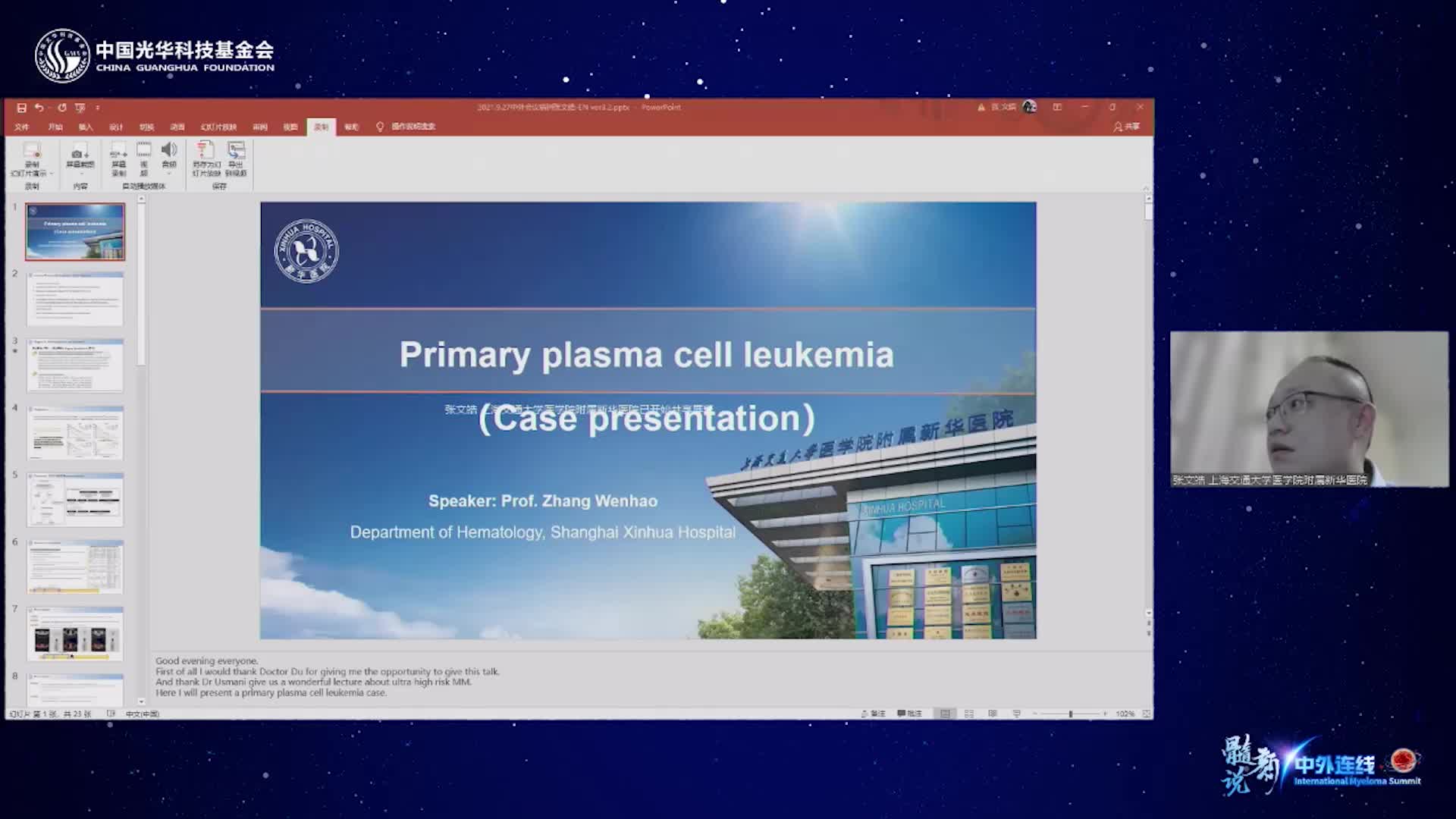
the jhg ducctthe john wen hhow from新na hospital history report with us just raise。
a good good evening。
everyone。
first of all, i。
i would share my screen。
i would thank doctor do for giving me the opportunity to give this talk and thanked doctor with money, give us a wonderful lecture about futual high risk multiple。
my loomor here, i will present。
a primary plluma cell lukimia kiss。
i think maybe plluma sell lukimia is a special type of future high risk extraordinary multiple millooma。
a seventy uh, a sixty seven year old mail complained of foutage with fever, which started two months prior to admission in november, the twenty thirteen。
on admission, its vital science was stable, and the physical examination was completely begin。
laboratory evaluation。
should him a global fight point one gram?。
per deilitor white blood cell count or full point four sales per cube。
michael leature with twenty percent, a typical emphasize and poliliate count of。
sixty eight thousand per microelature additional blood test revealed normal casdinal and liver function。
pariara smell showed about twenty percent of pluasmcsales and fluueton。
flows seometry of perry flat blood confirmed pluasmcsalls informer with pluthma cells。
CD one hundred and thirty eight positive。
a blue marib absy demonstrated ninety percent。
pasma sales positive for CD thirty eight CD one, thirty eight CD one, one seven and negative for CD six fifty six CD nineteen and CD ten。
unfortunately, we lost some important baseline information, free light chain chain, test, ad city and fish test were not completely because of economic reasons。
insurance that didn't cover these items at that time。
bone emission computer tommography did not review any leticulation。
pluasma celling former is a malagna pplasma ce l order charcharacized by presence of more than twenty percent。
ccuculating class mc sales for。
an absolute can't greater than to belielibit per meiclata pluasma cells in pariferal blood according to this, we think his final diagnoses is primary pluasma celling former。
呃呃,lukimine。
the the prognosis of pluasma cell lukimia is very poor, even treated with total therapy protocols。
portugus AATT one TT two TT three TT three contain some new drugs like potzare made。
for patients with primary per。
primary。
pluasmsel lukimia medium OSPFS and saturation were infer to those of none。
primary plus myself, a group as a whole。
first, line treatment of pluthmar selling allukimia is induction therapy with combinations of immid drugs such as。
the little mild and lend a little mild。
protisan。
inhibitsuch as podities of it and camel therapy。
alugenic or autoculious stem cell transplantation can further maybe can further improve survival outcomes in elective patients。
however, optial therapy is not yet established and over prognosis。
it remains poor in twenty thirty。
so we followed IMW to。
recommendation to manage this patient。
induction temotherapy was initial with bodies on me。
the little ma AA little md and dcks method zone。
after。
indition of this regime。
he started showing good clinical response after one cycle of therapy。
he showed no evidence of lukimia plasma cell。
newer plass blessing, although a mild。
elevation in his parapprotein level remained。
follow珊。
tometry did not detect a residue。
CD one three eight, positive population or capper expression population in bow marrow。
this amounted to a very good partial response。
VTD was continued from november twenty thirty to much twenty fourteen。
the option of stem cell transplant。
was considered but refused to buy the patient。
he achieved a complete response。
and was started to maintains。
the little md in much。
on much in march twenty fourteen, he was not shown any sign of relaxing classma cell lukimia。
the duration of his first response is。
thirty seven months。
in april。
twenty seventeen, he presented to hospital with two painless soft t shirts wewelling near his right ellioc and right elbow。
a needle balpsy of the swelling confirmed。
non security EMB laps of MM。
of multiple meloma in munal。
history chemistry, negative CD three MPO kapa lambda positive。
city twenty partial。
CD one three eight VCR two。
LCA parzzle, the patient completely pet city and the results confirmed disease。
relapps。
whole body FDG pet scheduled FDG optic in masses within。
right, pryr RR and right and upper right humorous。
syrium。
electral for。
electronfoases should marked monoclone IGG eletivation。
there was eletivated。
a swim IDGA eighteen point one。
normal syrim IGA and IGM。
immal fixation showed monoclone gammaa pathy IGG kapa tag。
so we found the clluma cell lukimia relaped ed, another, another form of extrtrur EMB。
we don't have。
we don't have a special guadline for EMM。
so we decide to follow the insistent guadline in twenty seventeen。
taking to account the。
availability of drugs we choose PAD regimen。
to start the chemotherapy。
the patient underwent second line therapy with botizomi lepo doxi。
libo doctor, rubisson and and dex methosom for six cycles and thirtellite therapy with lana little mind。
and dex methosom were started in much。
twenty eight to maintain the response。
uh his disease ary呃,evalue uh his disease。
reevaluation was SD or PR, because the CD should assize reduction of the EMM disease about fifty percent。
in december的twenty。
eighteen, the patient found a soft tissut swelling on the left chest war and。
FDG pass sccan had been done。
whole body pets sccan showed FDG uptic in masses within left chechest war。
red cruel of dive。
AA deappress。
and left。
clvical in january twenty。
nineteen the patient experienced severe。
necping and limitation movement of right arm MRI suggested a soft tissue on the right side of the。
spinal canal at the level of see three two, see four。
we didn't do the biup say we think that's the EMBPD again。
so the patient received a fourthline therapy with autizomid。
la little little, md, dogs, rubisison and dex metazone for total of sick cycles and achieved a partial remission。
next, we decide to use。
a combination of lindo mind, CTX and dex methosom as the feast line therapy from ox。
twenty nineteen to july, the twenty twenty。
in july, the twenty twenty, the patient found the ssoft tissue spweling on the。
red literal chest war and and pacity skcan have been done the。
we found we found FDG uptake in masses within the right rab and in numbers spans reliticble lesions。
the masses at the right。
accelerary and literary chest war grew two times larger, with with severe pain。
we found the disease progressed in another form of multiple mallooma in this patient。
the patient received a sixth line。
therapy with examined。
examine a leina lab a。
lena little md, CXX and dex mthofom for total of five cycles。
and the the best response is SD in december, twenty twenty, is IGG level。
elevated for the first time since twenty thirteen, he achieved CR。
the last disease progression occurs。
in january twenty twenty。
twenty twenty one。
the chest CT reviewed multiple soft tissue。
低首呃呃。
occupying and wite plr r effusion, the boom marrow smell demonstrated seventy one percent blesmars cells。
the patient had abnormal carur types, he received a seventh line ICDP regime with combination of。
exo mib dex metasm CTX。
pull a little mind later, the chemistry was suspended due to双lumbo syopinion。
the patient had severe pain in the right。
阿pid mass。
and received local。
radiation therapy。
unjanuary the。
呃,twenty eight。
two thousand and twenty one blood routine showed more than。
twenty percent plus ma cells, the patient was adjust to receive DPDPD regimme。
which contain a daria。
solo mejure and go my little mind or let a little mind。
after ICDP therapy, the IGG level dropped from sixty one to forty five, but this continue to the to thmbble syopopion, and he should should reflect ory to DPD or regimen or maybe the regime hadn't。
start to work。
the patient died due to karacxia and multiple origent failure origent failure。
in january uh, in february twenty twenty one。
呃,so we think HSCT。
a is an important treatment option for curing classmmer cell uchemia patients。
but we don't know ah is。
allugelcstel transplantation and effective treatment for plasmell kimia or should should allogenic stem cell transplantation be preferred。
i think we need more data from clinical child to give me give us this answer。
i from。
for a little mind or darrer resistant advanced RMM。
there are。
few effective options may be katty therapy a candidate。
a candidate option in treating pluma cell lukimia, but。
we still need more clinical trial to prove it。
only a few clinical studies will include plussmase lukimia patients。
the optimal milkinytelg include primary。
glasmcsel lukimia patients。
i hope this trial can tell us how to kill。
gasasssel lukimia。
here is the summary and summary and questions primaries have。
classmosale lukimia is a rare and aggressive disease with poor promisses, this patient relaxed with EMD, but not。
primary sale lukimia at first, then the plus ma cell return to the nest and cost letic bonlegion is the is the colono。
evolution of plasma cell lukimia。
the opposite of the clono。
evolution that is common in multiple meloma。
the patient experienced multiple drug resistant and die of pluthmas sell lukimia currents。
uh, we we have many questions about um the。
this patient or the。
plus myl lukimia。
the first question is comppatient with。
a just about twenty percent。
i plus myself in the peripheral blood can be diagnosed as plus mcell lutimia。
there is no doubt dir。
r ra is an effective agent in treating primary pluasma cell ukima。
and is there any available marker that predicted whether dirg will work?。
autologist stem cell transplantation and effective treatment for plasasma l lukimia。
or should we do some allogenic stem cell transplantation?。
which agent or regiamin, would you prefer to treat EMB?。
oh, that's all。
thank you。
okay, thank you very much for the doctor, john share the very unique case。
and we know the plusmsda came is very aggressive and prproducces h patients, but from this case, even it's disappointment because the patience side in easy januubut from the whole proceduand。
also, uh, the treatment to regime。
the patients is very successful because um pay。
has a eight years a long survival。
so from here, we can see even for the plus ma cell。
it's very high uh had to jaggers from the uh clone evaluation。
and also doctor john ressted, some question, uh how to this PCCA for the better treatment。
and also, we have the a lot of uh questions think from the panel discussion expert。
OK。
who will be the first run like to make some common or question for the dark jon's case。
doctor young。
谢谢杜鹃教授啊,我我用中文了,我觉得张文浩教授给我们带来一个非常好的也是就像杜鹃教授讲的是一个非常罕见的一个病例啊,我们说他从江白开始还能首先是治疗效果哈,还能维持这么长。
我手头上的江白好像还没有这个能有这么久的啊,要向张文浩主任好好学习一下,再一个他的这个复发也很有特点啊,他以这个水外的这个病灶的这个再次复发哈,一这个的江白好像复发,也以这个这个江细胞白血病的形复发发好好像还很这从整这的的一个水病病。
所所以我觉得从整体是这样的一个治疗跟这个呃整策策略上的考虑来说,我觉得张浩教授授是非常啊很详细啊。
在这个汇报中,那关于您提的几个问题,其实我觉得我也挺困惑的。
其实在这里也正好可以请教一下,比如得。
我觉得在我手上江白好像感觉他们去推荐他们去做易斤。
造血干胶癌移植成功率不高啊,我没有推荐成功几个那么字体我自己没有嗯做过江白的字体。
我总觉得这个江白的字体不知道这个疗效怎么样哈,可能我更会推荐易斤,但是易斤确实我没有成功啊,而且我手上用zara的疗效也不好。
就是确实我也不知道有什么标记物。
所以您那两个问题我也特别的困惑,不知道杜鹃教授等会儿能不能帮我解解惑啊,我这当然用了一点都没效果。
所以我也希望能不能有这个更好的这个治疗的策略。
比如说我们有新的手段啊,那我们有KRT治疗一个原发僵白的帮他维持了一年半将近两年,但是还是会复发。
那可能接下去就治疗比较棘手。
像比如说XQY抑制剂啊、卡非唑米啊,这些我们也尝试,我觉得可能比较好的手段,可能还是这些新药去在帮助他吧。
啊,然后呃关于这个百分之二十可能老早也有这个界定了,就是是不是百分之二十,我们现在已经不太限定在百分之二十了。
但是我们中心大家还是采用的是百分之二十多啊,我我我们还没有这个长,就是低于百分之二十去诊断的,目前还没有,但我我我也。
听到过,比如说百分之五啊或者多少,就是不是就可以或者有克隆性的,是不是还是可以考虑?。
这样的一个情况。
嗯,我很想请教,就是呃张浩主任一下,就是您那个病人后来在水外病灶有没有去做病理相关的这个基因的测序啊?因为他水外病灶我觉得可能是不是会有点什么相关的特点哈,会不会给我们一些什么提示,谢谢。
谢谢一杨教授的。
啊,沃是。
要要要翻译吗?这块。
需要翻译。
despector's money is still on level。
yes, i'm still online sorry and integrator a place。
yes, yes, ok。
well, i think the casis uh very impressive, because firly, i think think myself already find PCL patients with such good efficicy y still insurvival, even though the m mdeum and and dedeth h usually insurtithe。
i, but i'm a related in it is still in PCL rather than EMD。
so i do appreciate specific and detailed introduction of the case in terms of the questions that raised at the of the presentation for i'm interested in it。
so maybe i can respond to it first well for PCL, whether of trspsptation tation or alloous transpentation is for myself, self recommended to my patients about allo several times, but i haven't been able to really succeed in convincing, my patiented or autransportation tation auautranspsptation tation。
i myself。
is not sure about its efficicacy。
so at least i haven't been really recommending it to my patient in terms of dara。
i had similar adouts because i haven't found efficficacy or activity um urea in treating the PCL patients。
i'm still very, very much curior about tisible makers or other region that we can use um maybe in treating PPCL primary PCL patients um but still um, but usually um patients we unis s one point five or two years, um maybe we can consider some other new region that appeal one inhibit or carea。
but dara uhave be finfinal consision of what regimen could be better or preferred。
another question is, how do we diagnose whether a twenty percent also pass mmself perpertaent?。
we be diagnosed as PCL in my commnical practice。
and in my center, we still use this twenty percent or above twenty percent。
really, we diagnose patients as PCL, if it is of only less than twenty percent plus myl, i heard myself that some of the patients were diagnosed as PCL, even with less than five percent like plus myl。
or if it is of colonial um feature, then that could be another feature。
we can consider or diagnoses PCC。
even if it is within five percent plus myl for EM my vision。
uh, i have a question to whether we find any genetic sequency would be a useful if it is。
uh relarelaps with the extra medual lation。
thanks for your question。
i have we want to do some biopsy, but the patient refused。
so we don't have the chance to get in love。
material to do the indilis。
maybe you do the NGS um some XO target drugs, maybe the plus to the regiment。
可以听也耶耶。
ok, i think for the diagnosis criteria呃。
actually, it has already changed, such as already some data from usual。
and from the mal clinic, i am sure the doctor or's money has a lot of fix, very some, as。
would you please share your comments or your insight?。
on this fact。
thank you。
thank you so much。
uh, you know, II think this uh case, kind of highlights um an instance, um you know where uh the patient actually did better than expected, um um with the treatment that would pick。
i um you know, the uh presentation and the course um you know is um um a little bit um a typical。
and this is where unite。
i do think that if um if we had the opportunity to to look at disease biology um um uh the irculating classmyeles um if you know extremeticary side potentially um um with could consider um novel small molecules um but that would not be standard of kay, i think we would still be left with, um you know, trying to pick um um you know that new where mechanisms of actions one drug that also comes to mind is selenexoor um。
which is an export in one ina bit。
it appears to have good seen um um extremeary penetration as well。
and and that is another one that could have been um。
um you know of of intereso。
so that's kind of you know, gh where i would leave it。
i do agree with the rest of the points made by my colleagues。
the deductive ves money because um i think the PAPCL is very aggressive。
normally, the pictures will h have very short survival, but。
um it should be has another prognostitic model such a process system for the PCL, because um they really have the different the big range for the survival, some pation very short, some p very long, just doctctor sypereven long than eight years。
so um from your opinion, which parameters on which attem come back together to make the risk system。
uh, the microphone, it not still note。
okay, yes, i'm sorry。
i missed the early part of your question。
because of you know, i'm having some ouble with the wifi in my my location, yeah, for the because we the such as the revise at the stage for the riich for for the risk stage of risk model, but for the PCL, but for think we should have the nofi um。
risk model specific for the PCL may be specific for the EMD。
so uh, what kind of for parameter on which attem we need to come back together to make the model。
to risk about PCL。
i think that's that's very important。
i think you know the the risk certification mode will likely change。
um you know, in the future, we know that that you know there, there may be a change change the pasasma allukimia definition as well。
i think the cut off may change to five percent um or the absolute number of five hundred serb。
you know, there's an effort underway right now in the intermal milaloma working group。
and you know you may um heabout about it more in the next。
few months。
so you know, i think may be uh in another year or so。
there may be time to actually uuh change the HSS staging criteria as well。
for other for other experts。
do you have some question online? i'm not sure。
doctor, she。
okay。
thank thank you。
so so so have a great presentation for your case。
so in case of the journeney journey of eight years of to the seconsecond d ltium i quesm m uh ss, the evenvensecond MHPM quesis。
so my question is uh h to first second second。
relax, your abability shows that it is a agnonogy for the non secretary presasside omactually。
uh, she, he is posive for the IGGIGA positive m imppoting。
so why to think why do you think it? it is a non secretary。
III, think i don't know the answer to the。
helhelps the materials show, the nong secretary this, but we we do found some。
uh may be some resional disease in呃。
in his blood。
ok。
so i think this is a secretary, not not nonsecurity。
why?。
so, my uh, my common is that the presson side oma, a prima, a primsel lukimia, just just maybe be some some casit's。
it's like like you in my law, d lumemiookso。
so when treated ated is a lukimium。
and when when some patients relarelax get relaxed, it is is, is it? it is paent ts multiple uh my longest staff coma。
so in that case, we with you need ded to see that systemic treatment。
so so i think initially pripriassiside oma i will in my practice。
i will prefer the double。
double transplantation for for when when is when when a patient get get into uh MRD negative status?so what's your。
was a comment for AA doctor was money。
so about the tuior, what what do you? what do you think?so what for a christmas sell lukimia when if they they are tting get into emmar i negative。
是我的位置。
我的位置置。
就叫他们就给不得。
so is the question that if patients with primary plass must allukinia are。
uh, getting into AAII negativity and then were okay。
do you do the tranansplantation tation ello verses? s though?。
so auto, but just one auto um no, because even with tendem transplants um in the total therapy experience, um you know, we we did uh extend the overall survival, the media overall survival for those patients was own, you know, less than a year and a have。
um so the preference would be to um um give consolidation or maintenance with um PPI imid ge combinations for those patients。
um now you know can, um you know we there is no right or wrong answer。
um there you know if you still have patients who are MI be positive or have significant disease。
um you know, if if you want, can you know go for a second course of mmalfelan hydos malfelan, i think you have you can have that discussion with the patient。
um you my my yas would be that you know now that we have um i ty self therapies ies to develop protocols。
um you know where um you can give carty instead of another auto, um you know, or carty instead of another hello for their patient to drive the disease。
um you think that those will be the more interesting, you know, questions to ask and um。
option to offer to patients uh rather than a second or two second DO, you know or or or an alo um and if i consider an alo, you know, i would think about a reduced intensity。
yeah, so i'm a transper uh。
i'm a doctor transsper transpfer and doctor。
so i would just say um many doctors feels that this is a uh conditioning therapy modification may improve the survival of the allogent transplantation recipants。
so so a york centre, so what what kind of condition videos um intensity? so。
what kind of arrangements reduce ed said intensity to could you uh, will you give in to the patient?。
搜用诺爱立星音乐。
yeah, it it really depends。
you know, i think our our preference uh in the past has been flsiety BI for our patients。
you know, um we have utilized memeal in certain instances as well um as well as you know, if we are looking for more mlobzbut kind as prote bsize has been utilized h。
you know, um you know, if utalked um uh ten different transplant physicians, you will get ten different。
you know eleven different opinions。
uh, you know, know, know another preparative regimin in those settings, but those are some of the ones that we have utilize in the past。
so is any rofor the for the a novel agent, uum addition and noroual agent in a condition region um as well as。
i don't know othanks, you know, II。
ok,哎,thank you。
对,is there any question from。
are the guest。
ok。
okay。
i think we have very good talg today。
i would like to appreciate our speakers。
a doctor was money and dedoctor jhg and also our guest experts for discussions well。
and we have wonderful in the fruits for time today。
we focus on some hot spots in high risk much by by anomma to um cucuson lots of very。
uh, a lot of questions。
uh, even though we know we still can't to cure the hyrisk manimum patients。
and also we can't to solve the tough question today。
but uh, i'm sure we will move forward one step to understand well, uh at a high risk much a matamum patience because at each siminar。
uh, uh, i'm a。
good communication and deeper understand out their sub groups。
i would like to sex the johnsson again for provided this platform。
and thank you, everyone。
thank you very much to share yeah, experience, and a lot of wentiful talk。
yet rowas money money would please make a cloer again。
no。
certainly, i think we've had um very good discussions around uh high risk features how to identify hiririst disease in year year。
twenty twenty, we also disdiscused uum, the various new ansces with some of the high risk features, there can be herrogeninate in terms of outcomes。
um what we do recognize is you know, picking the right treatments is the step of the way to give your patients, the best chance of getting the best deepest response is the ideal approach。
um we talked about uh et ined uh treatments with PI eid id st combinations, the role of uh antibodies like direct mumomab。
um we talked about the role of um autologious and elogeninic stems will transplants and the existing data as well as some of the novel therapies, such as you know, carte's self therapies。
and some novel small molecules in this space as well。
um all all a very a good discussion, very good points made by all colleagues。
um unit was a pleasure to participate in the session。
and i hope all of us are able to meet face to face at some point。
um thank you so much for the kind engagement on your part。
okay, thank you so much。
uh, we hope the common ninety can be controlled us souras possible, and we can meet to importance next time。
thank you。
ok, thank you, everyone。



扫码下载医脉通app

扫码关注e脉播公众号
请您先同意隐私声明
成功取消预约