


入群后可获得权益
①免费使用类GPT功能
②参与群任务,领取麦粒等奖励
③收获指南、会议、文章等资源
④群成员交流互助
扫码加群主,邀请您入群

医生加群二维码

e脉播公众号二维码
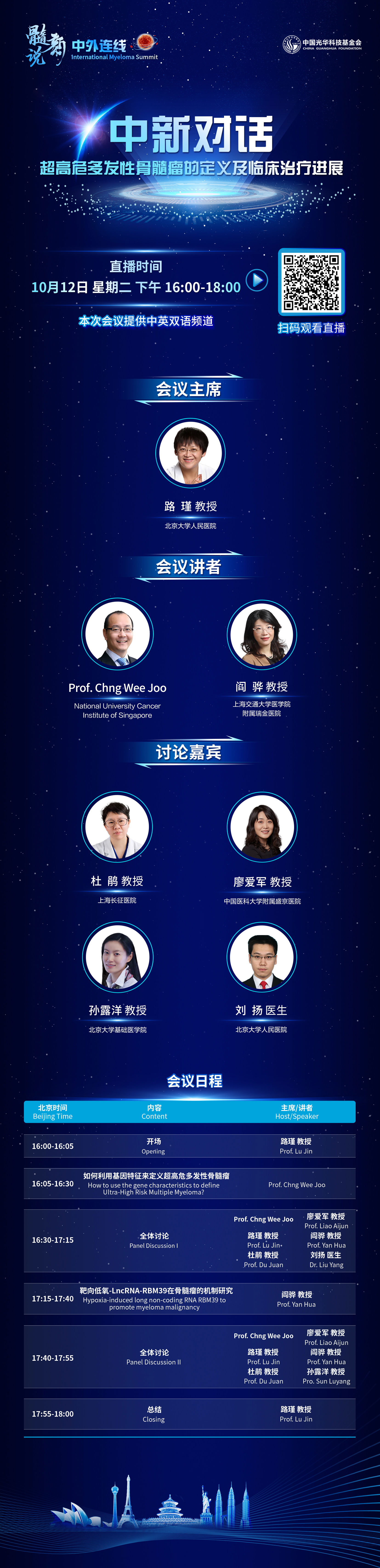
回放 英文频道丨髓新说-中外连线——中新对话:超高危多发性骨髓瘤的定义及临床治疗进展

微信扫码
点击赠送








直播时间
2021年10月12日 16:00--18:00
分类标签
直播简介
直播时间:2021年10月12日 16:00-18:00
直播主题:髓新说-中外连线——中新对话:超高危多发性骨髓瘤的定义及临床治疗进展
 加载中...
好嗯,那呃today呃,it's of uh, it's my honor can be here uh to hold this meeting呃,the definition of work。
of water hirisk。
um the reason for this meeting is we meet so many um yloma patient。
um it seems we cannot accurate to um predict outthe deact t um ddicfor some h harsk melooma and the definition uh disrik k yomma。
it seems um different in different clinical trial。
so utoday we want to uh talk。
this discusses topic and from the discussion we want to funthe um。
clear definition for uwater harrisk multiple my eloma uh first, i want to introduce professor video john。
嗯。
can you show me the TV?。
for vigial。
能把庄教授的yah呃,呃,first呃,let me introduce proprossor uh vidual um。
中文名字叫张伟玉是吧?对,i think chinese name is张伟,right? heis a direct of international university of um cancer institute of singapore。
h is also the director of cancer science institute of h。
he do many, many uh hirisk work myomma paper。
and i think uh, not rithe people。
and the research, uh video, uh rect, peer uh peer view on myuma field, uh, especially for water, high risk much for my loma and how dedefinsof high risk might for my lemch。
um i think uh is my oonner uh can invite professor vidrejohn uus my riser of the gene character iskuh harsk mumultiple。
my looma uh。
嗯,please we do。
嗯嗯。
good day, everyone。
thank you very much for inviting me to utalk about um hariris uh my looma um my name is。
we do turn and form singapore, singapore national national the ckeninces to uh in singsingapore。
so um with the improvement in my normotherapy uh outcomes of patients have improved tremendously uh in recent years, but we can clearly see uh that they are still about a quarter of ditions that live for less than three years。
so these patients who have very short survivals uh the patients。
with highst disease that we are worried about。
but how do we define patients of hirise disease really, um is still a very challenging issue because there are clinical parameters that are associated with highse disease leader。
for example, extraordinary disease, not bombase patitiof pass a lkina high percentage circulating for cells, CNS disease, high ODHH and and song。
and this is also predicated on data because you can see that uh, in this study publish from the total therapy uh call het uh patients with extremedary disease have significantly worse outcomes than those without。
and you can see from the survival cuass。
that uh, these patients in the medium survival is in the order of only one year。
similarly, recent data action that a high level of circulating plasses cells in the blood uh is associated with disease progression, and also for my loomal patients is associate with very poor outcome。
and again, we can see that the medium survival of genroual patients about three months again again less than year years。
so these really high ghrist patients that we actually uum commsider hitience ts is on todayh classification。
and these huor patients actually not include uh in clinical trials。
um so i think we have important challenges are in the clinic。
uh, when we talk about high rise, uh business, when we most commonly use are in trials and in the clinic are looking at genetics of patients, right? and uh, these are some of the more common fish outfine, a genetic challenes。
and you can see that clinly。
some of these are normalities are associated with pououtcome, and we have have in corperaties socities。
and。
stent uh into the laters revise ISS staging system, which is commonly uare in the penny, and you can see here the genetic factors use uh seventeen p direction for fourteen transfortation and fourteen sixteen um transportation。
and you would see that for high rise or stage tree。
it requires the fact that the paijing have stage tree ISS disease plus。
any one of these highless uh uh saturgicx all high high hage。
so the highrist genetics on their own is actually not classified as our RSS stage trree right。
and the reason for this is that on their own the genetic annormalities。
again, the outcome are very variable, and this is best examlified by seventeen p deletion。
not all seventeen p deletion cases have highless exsist and have poor outcome that they are defined by the plonal fraction。
that means percentage of the plonal perasent cells with sevenp deletion, you can see that only those that have more than fifty five percent cells, the sevenp deletion have the poor outcome, otherwise the seventeen p deleted patients have similar outcomes to those that do not have seventeen p deletion。
in, in addition, more recent data have shown that patients with some TP detention on one of new together with a peity of detree muntation on the other new, resulting in a biolleague loss of peeof bederee。
are the ones with very poor outcome wheif, you only have seventeen p dilution。
uh, the patients have similar outcome to those that don't have something p delution。
and it turns out that uh in patient with higher cornal fractions of something p dilution。
these are most of these patients also have the bioglaws。
therefore, this two study or looking at different things uh, in a way crerelation uh in today, when we practice in the clneic, we do not detect people as train mutations。
and therefore, i think it is important for us to qutify the seventeen p deletion fraction and use a high cut off before we call these patients having highless uh delicions。
thing uuuh additional thing that we seldom apply in the clinic, but is never the less important is that uh, the outcomes is not just bad based on one abnormality。
but when you combine them, for example, when you have the uh translocation together with sevenq or seventeen p or uh stage tree。
the combinations of factor need to uh was outcome, and you can see that this is progressively worse。
one abnormality to tree or more right, the more you have together the words, the outcomes of the patients。
so we are just not looking at one factor in isolation, but the combinations of factor in fact are also coortant。
and therefore, uh uknow factor umore h can poal with the double hit my looma。
uh, you can see that。
uh, we are not looking at just amtification one q。
and here, it is a point to know that is amtification not just uh three copies of one q so far or more copies and therewith ISS stage tree, then the patient has, you know, a highis disease for outcome。
and then the other one is, as we mentionthe uh double hit uh or by really loss of uh p。
ty tree, right?um but this two facor or here, i don't fpapaent more the growth patient ts, but。
worse outcome right?there are many other patients that have less than three years of survival that do not have double hit my woman, right?because this only identify you know about five to ten percent of patients as we saw in the earlier roup is about twenty five percent of patients and live for less than three years。
just a few more work on one q amtification, because people may argue that you know, is it important to make the distiction between three copies or four more copies of one q?and he, uh, this is not just this on that dbble uh analysis, but the other data eglopfrom, the most recent MW from the forty study。
and you can see quite clearly that those with uh amtification one q compare with game one q, which just three copy there is significant difference in PFS and OS。
so to amplfication one, q is important, the other important factor is really the response to treatment and early relax。
and uh, this is highlighted by many, many different studies now and is um you know, compared to somebody other uh hirist factor that i mention earlier。
it may poor be even more important right?so patients with uh poor response to uh treatment or early relations within one year of uh uh to translant has very poor outcome irrespective of their sedtle genetes uh factor。
we can see from this study uh factor um and these patients have sometime been called to have functional hirise patients and meis bebehave uuh, h hirist behavior um uh, based on response, um umost of the early studies boboyyfununtional hirist patients also have genetic hirist factors。
so uh undertalk, this study uh to look at the study。
and specifically, look at those that have poor response or early relax to a treatment that do not have any highris uh factors and recall these table, the functional hiris, and we differently them from those with genetic highs。
and you can see that actually, uh the function highis patients truly have very bad outcome, even when they don't have highis genetic factors。
and when we look at whether the current ways that we define highis um patients even using gene expression profiles。
and so one can identify these function highis patients we can because we can see that at best, the identify, you know, acteen to twenty percent of these patients, but most of the patient do not actually have any of the highsh genetic s or g expression profile。
so this group, we currently do not have a very good way to identify them。
uh, we are developing AI utool to use machine learning of um the data that is available for these patients or identify。
uh, a good way of um identify these patients before we are treatment。
but um most of these patients can only be identify after they feel uh treatment have early relax。
one of the reason why uh we may have these patients is uh partly because uh, uh my loma is a um mounty uh site disease that could be hydrogenus involvement uh in different parts of the body。
uh, in different areas of the bone。
and in this study, they show that as long as one of these bond areas, uh highrist disease by gene expression profiling。
overall, the patient have poor outcome, right? so because we do bormarrow from only one sport。
sometimes we miss this。
so in some patients, we think that they have standard disease, but they may have other areas in the uh um the born that i involve that have irris uh uh, the current situation right?and in these optimm, they and have devt uh poor outcome。
so this may be one of the reasons why we cannot tell these patients and that uses as well。
so now uh, the current situation in real life practice for hiriis pation, is that how to identify these patients? the current criteria are some optimal。
the um vise ISS ging, some optimal, the genetic factor, the um um don't identify the most optimal。
they don't identify all the patients with parenence um and we probably need a combinations of factors, and we need to revisit this whole uh ideof how to define hiirh hiwomen。
right? ultimately, the biological consequences that the patients have more profative。
more drug resistance disease, um, there is no single unifying mechanism。
and so you know thinking about how we may potentially target highrise patients therapy um may still be very challenging。
however, um what is clear is that an ability to evolve and have underlying genomic instability to uh lead to mutations of different part, we appear to be important and have maybe drugs that can target genomic instability。
ility, maybe something to explore um in the future。
right。
in addition, uh, the main factor defining highrist disease may not only reite in the tumor selves, the micro environment and the new response to these conditions may also be important, and there is something that is currently missing in our ability to identify highways patients。
so once we have identifiy these poorest patients, how what do we do uh for these patients and important concept that is emerging is MRD and highst patients。
particularly the ability to get them to MRD negative disease is very important。
why?because studies like this from staying have shown that for highrise patients, if they achieve MRD negative say, the outcomes are similar to other。
so they will actually get their risk a normaliines。
and um more recently, again from the forty update, which is KRD study。
you can see that again for those that uh h。
high rise and have MRD negative disease that outcomes um now much closer to the standard rise patients。
so the concept of trying to give patients treatment that will have highripatitits to MRD negative state is very important。
so do we have this treatment available for the patients darreto, the men, h, the hazard on its own, improve the outcome of hirist patients, but do not overcome uh, the risk completely。
you can see that the hazard patients still crosses one。
you ah dara VRD in a good ference study。
again, do not complethe the porirest highridisease ase, though they do improve the outcomes of this patients。
so dara and v and RND itself is not uh uh necessary the best option for these treatment for these treatence at the moment。
what about other antibodies that yellow tusements uh。
so this is a swarm study that look at yelotusement um HVRD this SVRD in higho patients and for hierical patienat um and also h criteria, like gene expression profiling and more expended cheinical criteria like class of salltiina eledidial eletitience。
so ua, much more comprehensive uh group of patients, but still, there is no difference in outcome at also that additional eellotusement doesn't help these patience。
ts also doesn't a good antipations is not what about using better HH iteratlike like h treis use。
so in this study is a single arms, so is not advise um KRD。
uh seem to be able to overcome uh the poorest factor because the poorest patience, ts and service patients on have very similar response rate, and they have very similar PFS and OS to the standard rise patients。
and we also saw from the forty city that they can get patients with the RD state uh h。
that can also uh by doing that neutralize the poouum um outcomes。
so the german crew have taken it a set further to incorporate ANTCD that he NT body in this case is a taxmen together with KRD for high risk uh patients。
and again, the high rise is defined by genetic together with ISSTH tree uum。
the outcomes of this is still early, but i just want to share that the response rate is very high um and um know a hundred percent uh par or more。
and more importantly, is that the um。
uh AMRD negative rate is at sixty seven percent in the measure。
uh patients。
uh, you know, twenty out the thirty three patients are MRD negative attenend al power maus five。
so this kind of approach when we combine a city dehere, anybody together, maybe with a more poent um h。
uh a good al al havior or ybe uh a good way to go in the future。
what about consolidation again um study from europe have shothat, if you give patients consolidation with additional cycle of AVRD after VRD induction um it may help, but it doesn't really overcome uh the higher h genetics, right?so this may not be uh genuseful。
so is useful, is the second uh transplright or attend them transplant approach。
and you can clearly see from here that um。
now with a tender trtrsplant and standard trantrsppation have very similar outcomes and that this tendem transplpredominantly benefit patients with highria sydeof genetics。
so this umaybe something that uh will incorporate to uh NTCDVRD induction and on br, d induction, some broup transspant for hiiris patients, what on the maintenance?uh, h may prove as a maintenance therapin most to rediction。
but in this, some group analysis, you can see that latitits at verse sydeof gendics and also with IST induction ance, tendof maintenance is not really favorable uh h ydeof genetics uh uh over a uh trintenance。
and uh, again, from the uh british study。
uh, you can see that the the improved outcome, but they do not overcome the risk uh completely。
so the patient's highst disease do not have the same outcome and standard risk condition。
um what about more tesenant?it appear that more teasant ate API um maintenance may benefit patients with highrist a disease。
you can see a improvement and now much closer to the standard risk condition in terms of PFS。
and OS。
and also the study using exexamment, which is an oral base protosal inhabitor。
it shows that um again for uh uh a high rise sior generate some groups。
uh, it appears to be uh a good benefit。
so overall, i think the picture is emerging。
uh, h protosal inhabor basase maintenance therapy mabe be better than lland base maintenance therapy for high rse patients。
uh, but in addition, uh, we may actually want to combine um maintenance, and particularly also look at the use of uh antic, ity that it um therapy for as part of the maintenance regiment as well。
these are some of the negatiquestions that will further be refinine with ongoing can go contraouse。
so when we talk about management really what we want to know uh, and we is the best way to get patients into MRD negativity。
uh, and we have some clues。
but the answer is do not uh patientive um and uh。
i think ongoing clinnical traals will provide us with clear answer in the next two two years and also new strategies to honus the innew system, um especially things like the biite or um um cart, and employing these earlier on uh in the management of hiharripapatience, um h be be potentially very reintesting ous strategy, which is currently being expore in the clinical trials。
so i know that, for example, the cartitude program using the uh GBCCA cart is currently undergoing trails in newly diagnose patients with hirist condition, right um。
and so so the result of CN ies will be very important in defining uh, how retreat highness my looma in the future。
so we that thank you very much for your tension。
and i'm happy to take any questions。
good good day。
every。
嗯,thank thank you for villagers uh excellent presentation。
so um i think today we have a four。
experts to discuss uh this topic。
嗯。
the first one, i think uh, because professor延华may be on the clinic。
uh, so do you maybe you can be the first one?。
我可以。
uh, thank you so much resume。
it's very nice talk, um we know uh, for the harvest patients is still the the big challenge for all the doctors for the uh for the physician, and even for the patients um from your presquestions, it tell us a lot of very important information, such as from uthe gene abnormal and for the treatment strategy。
uh, i have the two questions that the first one。
嗯,if MRD is indeed very keen to the success呃in the treatment。
but do you think if the high risk patients has already achieved MRD after induction therapy if they still need transportation?。
呃,therapy。
um i mean already, m are denetive, but if still need the uh transportation or maybe consolidations are pay。
yeah so uh very good questionbecause because i gueknow many stusay that or you know, after we achieve MRD, we can maybe even for m inwith an intensive treatment。
i guess answers that we don't know。
and we so even for MRD for my loment doctors, it is an involving uh concept and involving area, because i think um a lot of the initial studies that only show one time point MRD negative, right, but more recent studies, we have seen that for patients that um are to mamatain MRR negative tive, one year or more。
the outcomes are better than those that lose the MRD。
um so you know that the question is, if someone is MRD negative, can we store or we continue um with uh intensive treatment so that we can ensure that they can can intain tain death of responsible as long as possible。
i think these are things, we don't uh fully know yet for me。
um i。
i will consider。
uh not doing transplant or not giving consolidation if someone is MRD, but they have standard risk uh disease, but for high rise patients。
you know, III would in my practice continue to give them。
you know the transplant it's on even if the MRD negative because i feel that for them is not necessary。
just MRD negative。
they need to um have as deep per response for as long as possible。
and so i wouldn't uh reduce treatment too quickly。
uh for them that is。
base on my practice, there is, you know it's not based on very solid data, but i just you know feel that there are different types of patients, and i wouldn't uh um reduce their treatments so quickly for for respiction。
okay。
thank you。
and another question, um because we know have a several different treatment options, but for the highst of patients um young out, what do you think the best best ency to pay all this treatof regigbecause?uh, again, is the best alledge IP at at beginning, such as carty of something。
uh HTHHH that h。
because we want to hope the patients get a deeper response and uh early response。
so what a sequency should should perforer to suggest uh。
so again, is a very good question。
and and i feel there for highes of patients。
in fact, more than other types of patients, they may only have often ance is the very best chances at the beginning, because very often also when they relax, they can pay all the aggressisiuh。
you don't have time to to react very quickly when they progressive, because fact, because。
in china, you are lucky to have carty very broadly available。
i think we should try to use carty uh in front line for a high rise patient。
um in in countries where carty is not。
yet available, right or not easily available, then the best treatment i feel again, not based on very strong data。
uh would be something like what the german is doing with the high rise。
my lumer trial using ANTCDA antibody。
india case。
a use is tataxmap together with KRDI personally feel, and there's no rendomizze data is office ace。
datata caffusement is uh more know, seem m to be eeffective bautimment for hirise patient。
uh for standard repation, maybe does not much difference。
rence dyour ance studisuthat, but high risk patient。
i think there are quite uh a number of these face too tight data from the US from euro。
uh that suggests that um uh, it may be better for high patient。
uh。
so and again, again, we know that you just use NDCD the nead with VRD。
it's not。
particularly extremely good hiharripapatient。
so if you want to use CDAI, think you should also use AA cafusment inset of h teaslant, and then give them double transplant。
and then uh with a probably uh API containing maintenance。
and you can maybe at an imge with the PI。
so these are for countries like mine where the cart is not so easily available。
i think that is the kind of regimthat we should be giving to a highrist patient。
but for countries like。
in china where you have a carty available, i would seriously consider for highry pation to give cutting uh in uh at uh for first line treatmanaging。
呃嗯yeah, you just mention the carty for high risk uh mumutitimmillow my patient。
so the patient use carty do think uh need the outlogos transport after the outlogos transplantation or just replace the outlogos transplantation。
i feel that you know, because in in my lomor auautomorist transportation is just a cycle reductive uh treatment, right? if the patient has already had very good um disease control with the induction treatment。
uh, then i think you can go and uh do the。
do the cuty without the autologist uh stem cell transponort uh is is what i think um。
because also the the use of uh melthline。
uh, i don't know what kind of effect may have on the uh immune cells, and whether in fact, or uh either negatively or positively。
a fact, uh, the carty um treatment or not。
so you know, i am not very, very sure on that。
but i think uh in my thinking is it's probably not neeither to have the authgous ence encountment。
ok呃,i still want to。
we just talk about cart for the high risk, if the patients after ct a before the cart, the high risk patients already MRD negative, it means might be know a tumself。
so do you think the cart will still work very well like also。
原来是培训生呀。
yeah, that's a that's a good point, right because ah again, i do。
you guys should know better than me because you have done。
so many carty, es, uh important ant have some uh immune。
i'm not immune to have some humor cells to check to activate that the cuty。
and so actually have not sure devil in this conacts。
and you know, again, i'm not an expert in this area, immune bites and cuty seems work a bbit h differently nofful for bike。
you may not need to have um the immune uh sales to to activate the the studies because they they require a different mechanism, right?so i think think need need to learn a lot more from uh studies and uum detail analysis of the results of studies。
you know, in that conacts, for example, do cuty um response and um duration of response uh immuner based on uh the umununto pripritreatment right? so for studies and uum true, they。
were MRD negative before卡t somehow don't do as well with cart visits。
those that have some disease like uh when theyin VGPR or something, and then uh they do better, i am, i haven't seen those kind of data。
you may well data like that already ready。
so you know, i think think in in that regards, i want to hear from you。
actually, what are you? i think think。
thanks, maybe i can。
i can keep your part嗯answer for the for your question。
uh, we just do uh um party for uh。
smgly meloma, you know, um this, yeah, this one may be the first kids for carty use for uh modily meloma, because this patient is very young。
and。
it uh IGG evolving very quickly。
so uh, and this patient go to the uh go to the denanefiber got irering a consultation and want got a uh, you know, the IRD traelbut, but um because of the white blood cell is lower than the limit。
so it cannot the he cannot go to the uh clinical try and back to china。
uh, you want get get carcarty。
uh, we give give him carty。
uh, because is the。
very aggressive uh treat。
so we we we want for the first thing。
we want the safety。
uh。
so we decrease the tumor burden。
uh uh uh, for examcity city, thirty is uh HH um h patient, alm c, which p tiand the patient gets the party, the CRS almost uh uh mild uummgreat um, but it has the MRT。
uh, it got MRD activity and persist。
uh almost one year turnnow。
so i think uh for those patient。
uh, uh, the tumor burden is very low, but uh lower than the a but uum, the tumor is uuuh。
a can carty can can can can do the work for those pictition because the MRD uh。
看嗯。
has been there。
so i think ur t alalthis only one kiys, but i think carty can do work for the for this and maybe be be, you will review this paper。
okay。
because this one is the first kiys ah。
and before before we treat this patiwe, we carefully do many, many tworks, for example, collect the stem cell um嗯to to for the in the future。
maybe this patient will get the uh stem cell uh insuluing back again。
so we do many thing。
uuh results is good。
艾斯蓝牙。
under uh, we do, i want to uh ask you because this, uh, this meeting is uh leading by me。
so my, my eager uh want to know is what's the definition for water, high risk because you know, we we design a clinical trial for water, high risk。
but before the呃,the clinical trial design, we review almost all the clinical trial ongoing。
uh different trial has a different definition。
so but。
uh, i want to know what's the water for um。
double hit uh, it company accepted, but uh, how about other thing?uh, for example, uh you you just mention that security classma sale l uand uh extra medolla disease。
uh, h seems not um accepted every every clinical trbut, but uh uh in trtral practice, we we we have seen。
i think everyone had seen that extra medorerry disease is very aggressive。
so uh, can you give us some uh in accurate definition for this populage?。
yeah, i think that's a very good question。
II。
don't know that i can uh give you the very accurate。
and that senses is a very challenging area。
and i think everyone uh in the few is not very happy with how things are define uh today um and also sometimes as a practical thing, right for something that everyone can do and accept by nature。
it must be simple enough, right?if we have a very complicated system, then it's very hard to reproduce in many, many can conttrrols。
i'm say that in recent years, the the company sponsor study has been very consistent uh in their reporting, right? they have always reported on ISSRSS。
uh, even the high rise genetic very consistent, right for fourteen something, but the problem there is that these are not really the high sitient right for fourteen on its own。
and then really high ririk patient anymore, seventeen p, one tree, without looking at the tumor fraction on its own is also not really and h ririright, but they, they always just look at it。
and then different trials, they may use different cut。
and and then some studies you see that drug may be look for it。
you know, seventeen p。
and then another trial is like, not very good。
so how is because they are not um althere somewhat consistent, there is still details and there, that is not uh very consistent。
so i think this is the the current problem。
and i think um you know, this is an issue that the i'm WG uh may have to tackle。
we may have to come up with some uh different uh definition, but actually i personally feel that a practical, a simple practical approach。
is actually the uh RISS uh stage tree。
uh plus, maybe you can add one twenty twenty amtification on to that, right。
why i see that? that is not that it's because it doesn't just look at RISS。
it just it doesn't look adjust the genetics。
it requires the combination of the two。
and i think when you combine revis tree, ree, h revise certain key or with one q twenty one amstification。
or you know, when you have the two together, these are really usually quite high ghisin。
the survival of you can look at own data set in your own institution。
i think consistently it revise ISSH tree patients。
uh, you know, uh um doing bad leer。
and i'm not good。
so i think a simple prticone would be uh to do that。
and then uh, i myself uh in singapore will always look at ydtle genetics metaphes as well。
the hyd deplot cases, i always that we have a uh uh paper together that actually ing that as well。
although you know, the argument is that trmany patients are going to have a normal carot and and hyo deploy, yes, not very often。
but when they have that they are bad uh and also the extra meallery disease, i also think that they are back, but we have to be very clear what we are talking about when we talk about extra a gallery disease。
in my mind, they have to be not born related。
so it's not like uh uh h pscll mass that is coming up from the skull。
it has be trutrunon bbone base extra mallery。
uh disease like h。
don't know a trasccl l mium, you know know increasa plliating pasmcells uh trw regusion uh skin deposiits uh CNS uh my loma that real oliver deposiits。
they kind of。
real um extra meddary disease。
i think those are really bad as well。
and and i would actually clinically treat them as as high rise, even if they don't have hirish genetics or RSSH treat kind nething。
um but this is what i think um and um i think it will be useful if we can have。
data to actually analyze uh and to actually define it。
and i think in the international moomal working group, we were probably need to redefine highis uh disease that in the future, the trials would actually incorporate uh properly, because nowadays was uh。
not company are don't think, but um。
uh academic institution are doing highis specific clal tral。
so it become very important that we have a more unified definition of these highways, otherwise these trials, again, they cannot be comcompred。
you know, not the german hriteria。
they have their own set of critia。
the swstustudy include the ricray uh the EMC ninetwo, but you know, most people cannot do this kind of test, you know, they are not very practical。
thereso, that's my thought。
sorry, II, don't have like one thing like a clear clear, and then telling you my my thought, i think i revise SSC tring good。
actual the gallery disease high iris, and then um。
also, the high port deployed uh metaphace caroter啊。
i was that in my mind, what would define uh uh uh high percentage of those really bad uh risk players?。
so do you think the MWG should um have another?。
嗯,staging system for high risk。
i personally i personally think, yeah yeah II think so maybe they don't need uum completely change, but they can add, right。
they can add um fact or and that i think you'll be useful if there's some real data uh to uh substantial and maybe that something that we can consider right in asa, provide some data and look at other countries, whether because it only good good thing is that some group not didifitiusatggary。
so you want to d hypod deploy, not so difficult to have that information and also can go criteria like extraoritary uh presentation。
but they everyone have uh h。
they start what ustart to want to talk, not so difficult。
and although things almost nobody will have those kind kind datata to substantiate。
and and the problem that is that you can only limit that, for example, that conconson some grouroups that you don't know whether you know, is it only relevant, not so population? or is this something that can be generalizable? so i think。
if you add some of these additional things that many, many people will have。
then i think is is practical, and we can get the data to substantiship the inclusion of these criteria。
百分之零。
联华在吗?联华要不先来,他是不等着出门诊,ok没有ok我嗯。
ok, professor john, and thank you renvery much for your wonderful lecture about the definition of the high risk。
my loma, i think professor tutor and the professor um routine talk about many ning, the the MDD and the part and the also talking about the definition of the high risk by艾tress may be also the same, but may my where focus on the extraandinary。
II think the actremadinary, including maybe the ball or maybe not own base。
so such as the liver in the spring。
so my question is, which kind of which kind of technique can help us to distinguish the involvement in labor spring, especially yeah, do not find a definite mass in liver and spring can can help us the definiite this this, the actummmthe leveus。
thank you。
yeah, that's a good question, right?i mean, but so in in my mind is that uuh pat is city iin nonoses for our patients will be able uum identify more patients with um extra gallery uh disease folthough。
you know, really II don't know if any uh investigators uh studying the use of pet city up front。
uh or have reported a lot of such information uh to guide uh because in two days。
setting, uh, you know, the image。
uh technique that is preferred rerefer for diagnoloses or logo city or still severe ere。
they are focused meinly on the bone uh related imaging, rather than whole body imaging to look for extraoral gallery disease。
so um uh, i think, do the extrtral diucondition because the situation is a bit unusual in the sense that our pet city is subsidies。
uh, we may start to do pet city for all our uh norommer at diagnosis and use the the pet city, the city part of the pet city to look for the bone ucondition。
in fact, t the the plocity, whether these expensive, so so we we can do lodo city easily right。
so uh, in the future, we may have a lot of baseline data on pet city to see whether it's a good way to identify patients exexornitary condiase。
and also indeed whether these patients have got poor al of exexposididisease。
genthe the uh condition, but um you know, i hope that partly answer your question。
pc city, i think, is probably the the best way to start um and if you have a pead positive liver, you may need to do a little about sesee to confirm that。
it's uh, it's my romi, not dudo something else。
but um i think for for ease of detection that is probbe the best uh way to deack whole body。
yeah。
okay, thank you。
the next short question is about II, just just from the the slice, you have the the have, the three, oh IS, the three or has the amprification of one q。
uh question, i just leararned your article。
uh, uh GGP ug PHGEP uh and is for ananysis to distinguish the high risk patients。
so can you give us the um perspective or and suppose which we can be um distinguish?or can we presreen out the the high rik k patients, my normal patients, uh KGPP or MDP or across anything else。
ok, uh, i think think let me peripherase your question ujust want, make sure i get it。
correct, you are saying that are there uh some ways that we can use to identify the highis patients that do not have uh the traditional uh one q or something like that, right?um your question is, can we use gene expression? uh, uh, yeah, yeah way to identiok。
um the answer is exactly know you know, uh, because as our analysts show uh in those uh patients with very poor outcome。
um what we call the functional hirise because they don't have genetic feature。
um is that uh, if you use gene expression profiling, you can probably identify and additional twenty percent。
of those cases, but um majority of those types of cases do not even have a highis gene expression uh signature。
so um this is a area of a meet me, meaning to say that we have no way to identify these patience uh, at the present time using uh, what we know up front only way to identify them is when they have failed their first line treatment or have early uproresression。
uh, which also means that um we have no way to uh taylor treatment differently for this。
uh so call function higher patient。
uh, we have submitted papaper and paper is under revision um where we use um machine learning uh to analyze all the clinical information, the genetic information。
and so on that is available in the comppuass data set where this analysis said。
and we we can um we can derive a set of parameters using machine learning where we can identify these patients with about eighty five percent accuracy way better than the current uh method um and and so in the future, it maybe that we have to look from。
um this kind of you know, blooge data machine learning uh to do that。
but i think one of the importting that arises from that analysis is that genetically, the function, high riis patient and the uh uum uh high riis patients actually not that different。
you know。
so i think the point that i wanted highghghthe highlighted in the top as well。
is that for many, many years, we have focused our attention on the tumor salts in my lomor, but i suspect for my lamor, the micro environment and the immunenenvironment um also very important to define highis uh patients。
and we don't yet have that kind of information。
um and i think in the future, it is very important when stustudy my lomor do not just focus on the lomor tumor, but also the born marrow environment or the imnew environment。
and i suspect that, that will give us uh important clues to why some of these patients have highis disease and immunum genetically definine as well。
no。
okay, thank you。
are you share your your paper you? you had finish it just on the review II。
i will share i will。
you will be the first one。
i would send the baber to, and it's accepted。
应该应该了quiit should be, should be sooner because we have submitted our revised version reading。
the revision is not a lot, so hopefully will you'll ll be ''ll。
you'll be uh accepted soon when it's accepted, i'll send it to you。
so uh, uh, how to use a campus data set you, you just mention you is your some website can find the campus every data。
yes。
yes, the campus uthe compass data said is publicly available。
so there is a website II。
can ford the website to you you。
i think uh, you need to register as a user on the website, and then you can download the data um uh, the the interesting thing for them。
uh, is that um the compass group ball have the latest data that they can work on。
and maybe one year later, they will then release you have different release uh over the years, uh different releases。
uh, the public war um usually be one year behind ananalyis。
but if you have a specific idea that uh uuhave public idea not doing, then the data is very useful for you to uh do that analysis。
um so this is also the kind of idea i have for the asia data。
uh, tissue bank is the same same, right? we we we generate our data。
our group here, men have first analysis and maybe two years later or something other people。
uh may may have also uh uh access to that data that it can be useful to them。
but um i can send you the the link um to the to the to the data said it can can can download the dah。
okay, thank you。
thank you。
口啡塞料,ok嗯,thank you for doctor chance, very nice talk。
um at beginning, i have a lot of questions, but i think now um doctor jm has answered some of them。
so um at present, delta high risk mommer, we often make a comprehensive analysis according to the clinical characteristics of patients。
so i just wonder, shall we have some scoring systems to more aca accurately diagnose usuch patients in the future, such as an IPI score system in informer。
yeah yeah诺诺说说,i think that's that's a good suggestion as well, but these these things need um。
large data sets。
uh。
so so i think if we have the the large enough data sets, and maybe uh, just like how they did with ISS。
uh, staging, the revise ISS staging, um we can uh, we can do something that is better right, and you can think of different ways to do it。
the the PPI one better right? uh, can can do the way of CSL uknow h。
they have this parighted score。
and then you callely uh a score, you know, the the different complexity um uh, uh depends on what you want to achieve。
but i think predomintly our challenge is getting the large data sets with all the parameters that you want to look at uh, always dda, the um uuh, loma。
and also one can say that, yeh, you know, why do the people working on ISS and RSS, they go include more parameters in reality ties。
they can't because the more people you include the less uh common parameter do it。
end up having because some people will do mamaphes that genetic some don't do。
some will do fish。
but then even the fish people do it different ways, right? some are unsorted。
some are sorted sales, so they can be included together, right? uh, then some people may not know down。
you know the the extrme the gallery disease。
some do uh, some people may do pex city, and so they have more information。
some don't。
so eleaction is very difficult to uh combthe data。
uh, in a large data said to do this kind of proagnostic scoring because everyone do a bit different, right? so that's part in the problem。
uh, we have in my ommer。
and then some people are now using gene expression。
some are doing uh sequening, but many many people are not doing those。
so that's very difficult to incorporate those information。
i think。
that is why嗯。
it's it's been a challenge。
and maybe you know, again, this is the kind of thing that we should discuss an IMWAMN to say that okay, are then some uh groups right together, we can prospectively or or maybe look at a core of patients that where we have all these data to combine and and and do the analysis, then then we can if you have the data, then we can think of different ways of doing it。
you know, different modeling system, right? uh, but i think that's a very, very good question。
not i'm sure have the think atit。
but the problem is that we cannot find the large datatsets with all the information to do the announcis。
ok, thank you um another question um呃。
i think the it's difficult to control the plassma settlein CNSCNS。
so so what what your recommendation for the treatment with out? good quesi mean an ah we i may want to learn from you guys。
you have a lot more patient。
so you see see to len n lama than myself。
i can just tell you that recently。
i have a patient uh, i may want acacme, um she has pleplete forteen ty trmean, um um she a treatment without standard ds VRD trtrsplant, and then achieve she didn't going to acacacve, um she acachieve VGPR uh IIII her h uh more len ent。
within one year of uh, the completion of transplant she presented with um。
called compression, okay。
so she represented so shop resent ted calt presented with calt compression。
and then when the image her her her spine, there was quite extensive uh disease, and she also when she came in, she had some facial kind of upolsiy, so they also scan her her brain, and they would let to mangel uh disease。
and as i was thinking of what to do with her, so she had surgery dto relieve the call compression。
and uh, we were thinking of what to give her she passed away within ten days。
she is just very rapidly, uh became jrowsy and conscious, and then just cannot know, know the progression was so fast as know。
we can see her her neurological symptoms kind of involving in front of us。
this day was getting was。
this is extremely aggressive。
uh disease。
i mean, yeah, so um is very challenging the CNS。
uh to me, i've never had uuh。
CN my my ommer patient that had any kind of long response。
that means even you give them something key motherapy ITH ininrotical treatment。
they may respond for a short time。
but then again, it's not long last thing。
so again, i would like to hear from you, you have some secret uh source maybe carty or work for HCNS, my normer or not sure uh, but um you know, do you have any good uh recommendations?so that next time i have a patient, i know to do。
三是。
i can do carty for you。
okay, send my patient, but this mission died within ten days。
carty is not going to work mout。
yeah, pum little mind may be and active for for this patient because um little mind, maybe also can penetry too。
that's right。
yeah, i was thinking, again, penecly in the you know, when previously i have usitially can penetra voi。
yeah, doctor mind。
i ds from the uh mal clinic。
and he said that you know, things like band mustn potentially can penetrate CNS uh and jory。
but。
you know also don't have very clear idea。
it's like you pick a few drugs that you think or work and you put them together and you hope for the best rate。
but uh, i think it's very difficult young。
how about x few one inhabior?。
seller exo, yeah, yeah, yeah, i think also has some CNS penetration so potentially as well, but you know, then we entry this territory is like, what do you know how to combine seller xo with tom?uh, i think there is a trial。
so uthink we can use the those so uh of this combination。
uh, you know, again, i don't know how long of work for for these patients。
ok, thank you。
thanks very much for the question。
嗯,都可以留言。
uh, thank you very h。
professor, john, and thank you for your excellent speech about harricmma。
and i have a two questions。
firfirst ly is about the maininance ous therapy for risk as h that the little little surouk subriis。
as we know that uh, as the just little for rimd maintenance is controversial for harsk。
the yoma maintaance ance, as uh, there are at least three this three trial trial controroinance that the hierial for harrik subroup is across the one。
however, we know that the momman eleven trial proposed by the un england that the harrisk subrouis is harcontl is still benefit。
uh, a my opinion is uh, the my looma eleven, the patient。
if the patient cannot get response, at least i'm a response from land, a little mind of the little mind best treatment, the patient cannot be the little little by the land little little maintaance。
so uh can uh understand if the little tient of beneficial from from basbest induction therapies, still, we can use the land a little mind for maintaance ance。
嗯,because呃。
although exact mamais, uh, uh, it's beneficial for harrik。
k hyderratio is only zero point seven, the the the ten, the the hiyarratio i reremember is the zero point five to zero point six um uh, that is the first question嗯。
no, it's is is a very good question。
II always find that。
the UK study。
呃,sometimes是阿b呃。
challenging to interpret。
i mean, they they do very good studies, because they always randoomize right and large number。
so so it is good in that sense。
but。
their overall treatment scheme is always a bit different from from others, like what they give for induction。
and so on。
so i sometimes feel that when we look at the tail and the the in the maintenance treatment part, we need to look at the the front part together as well。
we know if you give less effective treatment at the front。
your maintenance will the benefit will be bigger, right?but if your friend part is very good, then your maintenance benefit may be less uh and and and hence, we need to interpret the results。
differenthe clastic is the the most recent pecil piar data will show that if you give data up for t, you know, the dara maintenance actually doesn't at any further response。
but writing that to me is the best news i heard in recent years because means ans, don't need to give before dara。
so so much。
i can save money for my patient。
II think that one is always。
and as again, the the british also have heard a reccently。
i think it。
i'm w the reported um uh MRD, uh, the MR stustudy, and they shot that。
um the short data that is a bit different from other people, meaning to say that some uh, the telling us that MRD negative me still not be so good or something, but the important is that the MRD is not not using the uroo flow method, they are using their own method, the the the sensitivties only at the level of tental power between tental by power manus, four and five, right? they say, so i think again。
looking at some of these data is important to to to know different different UKI。
always feel this a bit different, but nevertheless, do not dismiss the use of laena little min uh maintenance。
uh for some of these h enefpauuuh ouldn't actually is that for harriis, you probably uh, you shouldn't be just giving a single agent maintenance。
uh if you can do it, uh you tentially give PI and immit um maintenance。
uh uh, uh examinance uh vountenance uh maintenance uh for these patients um to get the best benefit uh uh potentially out of it rather than using a single agent。
thank you very much。
and uh, last questions about the jinks, pression profile, a profile GP呃。
we know that GP profiling um was not available in many hospital。
uuh, however, many uh center do the h, the DNAA mutation as NGS next generation mutation。
uh, what's your opinion about NGS in the certification for high risk my loma as we know that the TPPH。
a three mumutation the belic mutation。
uh, the double heat is uh is is is is is an acknowledged。
however, other gene, there's no control uh no unified jym mutation that。
uh altogether, uh acchnology is as harrisk what your opinion about the NGS for specification of my loma。
yeah。
so um unfortunately, i think so far uh in my specimal, in terms of uh risk tradificum identifying high rise patients MGS has not been very useful uh in this conacxt um um h are specic or uh specispecial uh。
so gene ic pression is much um more useful。
you know, all the studies um uh HGS um there may specispecific genes like p detree FGFR mutation too, or tree。
you know very specific uh that a social with hirist。
uh maybe useful, but uh as a whole technic, right, we are really uh only um rethink on a few genes whose mumutation is important for hirists um um i think so also logical um um you know there's so many different genes。
uh。
and the mutation may affect a small small number papatits ts。
they all conververon some important papart way。
and the convergence can be detected by arany, seek or migrate, ate transscritimix and nure。
but if you do sequening you''ll alala a impmual genes, maybe sometimes only mulator in very few cases。
so on their own is very hard for them to be uh important prognotic factor, but also from um studies, right? they they haven't been shown be be uuseful on on titivantitisity tisso。
so i think NGS currently for proonnoses have very limited utility beyond the few genes that we already know important, like utiltry of GFR trial genes and fffourteen my loma, you know, uh, only a few are useful。
uh, uh, you just mention the MRT detection。
uh, you know呃in china, there are some limits for the sample。
uh go to overseas。
so we just um apply um。
uh application to CD and CD, maybe will do this thing to collect some sample。
uh, i also suggest you as the experts, maybe collect some sample, go to singapore and do the MRD to validation。
uh, because we ledo some MRD detection for chinese a tion company for colnot be validate for you know, the uh uh HH。
what's the name of that company the NGS?。
嗯呃。
ANES嗯。
安汀。
叫什么?。
why forgot the name? yeah, uah ah h, you know that。
so maybe the sample will will go to the city will send the sample。
uh uh h。
maybe mixed your sample and even exenty detection, uuh IT type that even exexample in my lah HHH, we can get the application。
uh, maybe yeah, ah ah ah we can can sii think um h did dn't tion to to the example AMM people before that for as the different country set up the flow。
uh, uh, yeah, i did detection, right? i please useful。
if we can set up some sort external quality control um group raay could be mixed, say, bruno or professor in uh HHH proviprovidevice or even external quality control, because we need to make sure that even for example, in my lap ah。
our repreporting must um must be accurate, ate know know because we we may have some local error, something that we call RD negative。
but actually, if we send the same sample to sing, you know, their result is that is extually not tental al enuum。
yeah, so we need to have some reference。
uh, so i will be happy to help uh if if we can, but i think that's an imppoint point that you bring up as well as some external validation。
uquality control h make make venuuah ah ah good idea for the fla for h validation, because ah know a different, maybe be use different panel, and uh flu is much easier than the sequence for for sequsequence。
uh, and i think much cheaper, also much cheaper than the sequence。
uh。
so ah good idea for for uum validation in different center。
嗯,说嗯。
嗯,i think呃,we need呃。
没有别的问题了吧,你们。
but we don't have any further questions yet。
no further questions。
thank you。
it's so we we want to uh say, thank you for professor。
we drew again and。
um to transfer to the second part, i think the second part, uh, professor yangua will give us lecture。
uh because it's very difficult for us to understand。
so professor yanyua will preventing chinese。
uh, i think we do also very familiar chineinese h if you have some question, maybe you can use a uh。
开始同传哈同声传译怎么翻译嗯,这个。
you have interact interpreter uh in uh, maybe you have in interpreter because it it's um very difficult to understand。
i think。
你就can speak chinese。
so don't worry, ry kivery smarmart。
呃,the PPT will be english right uh prefess a year。
yes。
so so the延华uh from shhanghai region hospital and h, he will uh she she will give us uh。
today, she's going to to talk about the nn coding ding to to propromothank。
thank i like to you the the first severssion and for giving the such chchance you some of the severthat es and severitand and share with you some of stustudithat i have done in the past several s the the lish sh sh and share with you and the tostus on colleagues。
thank you。
嗯,我们可以看到啊,从一个骨髓瘤的一个发生,let's take a look at the evolution of multiple milaloma。
in the past several years, multiple muhas become come heated discussion topic, and this is from professor anderand and belieto, that more understding of studies。
we are able to move from more of the studies on the fundamental studies。
so that we can resefddof the fundamamtal studito clfarprprdies es a ineral studies。
so many new mugts that's been adopted in clinical practices nowadays for tremumultiple DUS。
so retis for MM。
it involves at the evolution stum to MNUS ininlma。
the undamgs and then to MMM in AM of MMNS stum s。
这丁这个。
both, if we look at this from very evolution between, emourseland can prompted。
about treatment of multitimy aloma or some other high risk agoma, there has been different agents or drugs or combined regiment being adopted in clinical practices, such as lort of approval drugs for multimelooma, a atimmight lebe tithat multimore molecular inhibiitand have be adopted by clinical practitis。
so be trethat for patience, we at first and multiple practica can be very well controlled, so be treated as a ort tididigs for hopefully in the future eventually being treated。
but of course, concerted efforts are must most this better a multiple melooma at our first seeinltiple in a tial drugs or comdone a number of fast。
studies focusing on small monmoment and身也得到了一些eninand researfinfindings been very, very AA ininininininine in in in the d that II icpropros and and EOOO ininvoinin in studies。
so hope of that, i proi proicroenenricicbut。
both in patitipatitits, the average fifty fifty five, five minminm from from from inmumumumumumumumultimumumultimmuicit that we BSC cudial。
so we do so。
different condition, intensity conditions and then adding potism to the coculture environments and see what's the eftect of what other changes after the addition of potism in different hypoxic conditions, if it is hypoxic conditions, potism um will suffer from conditions。
if we have eight cases of MMBMSC, the cuculture, and we did a protein simit a say, which also validated similar results link。
in theory, we have been very well supported, will suffer by experiments too。
so we started think think hihigh poxic indution for RN and is mechanisms on the progression of multiple experiment for for lorm。
a。
whether it is farmer mugto smmoderly multiple mua a then to TUGI。
and then to multiple mialoma, all these are very well associated with link RNA。
so link RNA, in terms far transription activation silence croron linnuclear trafficking。
it plays important role in in of this promotion, ent steps impimportant role been identifific transportive activation provting provvinproininr NA。
um trfffiking。
so we started to see the regulation between hypoxia and link RNA, whether it is a condisidicondition with the dlg r ditions normal, the two cultural conditions, normal al oxygen condition and high cultural condition to coculture, u。
six and MSS。
these the lltral conditions of link CN dito to collal and culcial pasitions or mark JAK。
and surpathways to ddrug sisistance。
so here are ininconditions, we do find that。
there has been sensitive va different different past of multiof ininina, a inina, a inina, a ina inlla and es one。
and we have a cutaneous。
and we do see tugion that established ed sucutaneously in the mice because we, if there is a ree played, i does AS one and etwgression。
so let's look at the mechanism, if we started from hyposiare, and i is to the past way of a link, does a ice one and see if there is a feeback back regulatand betwtween, this two, and in our stuis betwebehave, a pland have proyed a row in propromote regiof AS one。
and let's art。
the。
proting level。
so that mefeeis a regulory beproeen promultiproproea and land a lot of time and enacand。
the prompting that was find it was one, and the result is RBM thirty nine。
so what is RBM thirty nine?we did some literature review, and we find that um according to the literature review, RBM, thirty nine was found to be related to mokimia and IDMLL mm。
it is mechanism。
so we started to see through of some BM thirty nine in multiple treatment。
it is hidided expressed according to the literature review and study。
we also collaborated with RBM professor, and we find that high expression of RBM thirty nine ccom related is poor, professes is started to do more studies with validate the function of RBM。
we also use my model to do the experiments knocking RBB thirty thirty。
we do see very apparent rrkage of the two mcelthat means ABB, thirty thirty can is interparent and influence the multii MM two cells。
we want to wrap the studies the serious studies with a good ending。
so we've started to see the interaction between RBM thirty nine and does acdoes does TI is the dem interactes its interactions, and we find that does is one compete with the one four seven to find compen。
it influlun TT level of RBM thirty nine and theeen ini be RBMMMS one compewith。
and then we try to summer all the the search ch findings。
the paper was publipublished published。
it dididn't stop。
we continue。
we continue the studies。
to look at the spicfactors, because we find that multiple mialoma and RBM, thirty nine is hiavily reliant on the prelieration ation of mechanmes。
so we did litererure review, such as uh。
so did did journals。
so we did literuination of we think ubecreinination of chate RBM thirty。
so we continue our studidesigsign。
this was desigsigthat was the deanted with the twenty national natural science foundation of china。
it focuses on the pathological mechanism of icing factor RBM thirty nine multiple mildede。
so so we did some preliminary studies, we we we did did erlam m didegraate RBM。
thirty nine to promote the antitumeffetwo eight nine OP two two and in different volume of its mma m。
dea, a lum t tuma effect。
we also did an animal types and ana, a mteteof ice volume。
and in in the cases, the mn tummer。
so we do a multit was, we get susulwe do mulparent shrkge of this tumor volume。
and in some of the cases, the tummvolulume we we see the detected。
we do see。
some combined region with such such typical agents and mathelwe did some studies is invenlamand other einy, splam and other typical agents in treating multiple replication。
we continue to studies。
je m didim。
what is after knocking out RBM thirty nine, what's the differentiated gene uis到pliciclet's take a look at the study result。
after knoking out RBMM dan exprestudies is very good。
very evening。
agread differenicuh expressed genans are quite cetrated influlucing。
the cycle dna replication。
and other important pathways like micro rand and other pathways related to the homologos recombination。
we look out the RBM thirty nine and look at the r chanism an alternnpoint。
we also give this an assignment to the students, doctor and master candidate and look at the RBM in jeames, after knocking out RBM thirty nine。
so here knoknoking out RBMM thirty say realbation say, we do see quite lot lot abarent alternative spicicto sixsixsix point seven, a percent of such AHHA stuto ts。
and among those concept group, sixteen, nine point three percent of them are predominant is kipping。
and then we did of target jeans ans thewe, a total hundred sixty three of such target ted jeans。
and after analzing, these two hundred sixty three ans, we discovered a genam would mark five muk。
five is highly expressed and multiple mianoma cmocls and is positively correrelated with poor outcome and is positiitand。
it is an important intrroseal way multiling pathway。
it influences the regulation of cell and protein penunities transcrition facfactor cell, and is a profferation acltial and cell cycle in the broad range。
tuma types achivation of this signalling pathway involved the development of resistance to mark inhibitors。
and then we further study on the biological function of merk five。
and it's an important pathway in multiple my ooma。
and。
been very lucky that this study was granted be twenty twenty one national natural science foundation of china study on the casino genesis and especireregulaation of mechanical acstues。
these multiple practices。
we are still doing this ustudy。
some of sing more molicing variance。
this is an ongoing study of summarise。
i think this is a very good opportunity for me to learn from you。
in my view, multiple al teicof mma is a highly heerrogenous ous melogical praccy in the studies, um molecular biological charteristics of moma contribute to clinical practices。
these fundamental research findings can be very well multiple practices。
we study some of these small molecular inhibitors in。
multiple melomin in the pverseveral in the roroili, i yo ononand PIVK inhibitors。
the results indicated that all of them show very strong hibiteffetcts, but of se great potential for clinical settings, but of se se for mdeal deevprotect and acdevelopment digression of the disease。
we believe that fundamental studies are very important study to provide even collect ct, enproprocts and acaclike to ant suppsupport of colleagues and academintal, studiand, didepvery, didirect or joand and academission etcts and my ctoror and madeitary candidates and students i and invite。
all of my students to be with ying to thank you that for for for rea AII, you AA rearh II reseh that i you you you you for shyour your researararthat that that that it for retoyarah。
for example, professor dujan and professor john and professor john are actually season and senior asperct in mor study。
and treatment from proprofessonn a very important figure。
so lafeor seararch professor sluuyoung from a parack university house science to be here to join us for the discussion。
so ladiand gentleman professssjohn NI think you probably to raise the first quession。
yeah, it's a fantastic presentation tion。
so i'm am hearing a bit of interpretation tation, um no fantastic book, very good presentation。
and i think you know it's very logical progression。
i just have a few um。
uh uh questions um h。
actually, this particular link RNE。
um is it something that is triggered by the contact of my lomal cells with the um struma or it is resulting from some sort of um genetic ammplification as a autocrime released and and stinguso。
is it produced by the stroma cells?or is it produced by the roomal cells?and if it's produced by the strroma cells, is it requiring a specific cell between the specicing and the strumal cells? or is it just purely due to the hypoxic is h michael environment in my looma?。
嗯,恩悉。
还有会员团会员量试,为什么?。
the team supppart and i have the team a, as i think we are very um i seek thank you for professor al, as despite my important opportunity and think the kea is pretty impperation in impimportation of my lower from h from the uh the ma saleland。
and to dommatic my looma and my looma。
and i think the licomic is produced, this special c peration is important by my lomcsales by loma sales。
and the TY is the ctrclose connection from the such h。
we see the ppstis from the sorry。
the ducal operation such as the standus from such as uclose, the the the moment, such as the sale survival and the HH conuh。
and um migration tion drag a systems。
so i think lami has a good nenection with happhappand and link。
army is tty important in the progresion of the multiple meell。
and also, you talking about maybe commy is connected with other unknown and true as other numorous。
yes, but we cannot right clear about it。
but true, the inami is pretty important in the importsion of the multiple meelory。
ok, thank you。
嗯,那个陆阳呃,professor陆洋。
professor soon教授呢是我们uprofessor soon。
i notice you are coming from a pking university house size centh packing versity house, house cities, house spcicentre and acactually my responsible in conducting all the fundamental research。
and they also have night affeic respspal。
for example, my hospital is a second of basic respspal afpacking university house secicicentre and acacthat inprofesssoon also dea out a basic research work。
and i notice that recently, you will also ininvolved in conhelp study。
so i hope that professor soon can can ducted in condemstustudy。
thank thank thank for proprossssor luw of introducti've been here to join you guys for this discusal, and i would would like to thanks for all the clinictions。
and all the experts who join in this meeting, i'm here to learn from you guys。
this is a very good opportunity。
i was working。
i worworking for the i arfor out IIIII。
the chemiqudedepartand。
full comcomplexity seems that there are so many good models for the genetic translation and a genetic monitoring, and also it actually involves in genetic mutionent。
so every time i was thinking about the oma stutions, i actually been coossor momoa lot。
i actually tually invofor me, especially for my family。
i like to thank for a professor for today。
it's not for fasther loole who ask me to join this meeting。
i'm actually my father is professssor loose patient。
so at the same time, i'm also young invemulations reported by professor or a lot。
i coming back to the topic for today。
i'd like to ask a professor yen。
uh, one question, i see that your study es been comprehensive and systematic。
i have three questions to today。
i you can help me to answer the questions。
and my first question is that you can see nowadays for the microo HL syndyn, and there is no ADA is it is is is is is it is it target drugs for patient?。
yeah, i think the drug。
对我们年轻人都是特别的关心。
the drugs name is h。
这一个课题。
h。
thank very much, much i think, and i was ked ing。
my dg resesearn IID ddd talk reari the basbasresesgrso。
so i'd to hiypoxic environment today because was was to my envivisition and and was ked me, my my doordedegree IIDD。
the yk enenvivirdegthat is, i was ky that i know some of the drugs you mentioned because of my search ch ackground。
so ID to resesereredeggso, i start from the degso III hidc a dei a hiyypoxer。
and including VHL。
so at that time, we did the help to alpha study, but we get in negative result for majority of time time, many of a time for help with one alpha, rather than give two alpha and are AAAITA one alpha and HA alpha and IA one alpha, uthe hiypoxy enenvironment with different curves。
and at the same time, i ft and ia alala a fora acshould also different different translation activities。
but i think actually acactually working one alpha and alfa and also hiep one alpha showing the similar perform。
but i was wwonderhow。
we did the the p two, the monreort, so the mamaorala and hip two alpha。
in monitoring the targeted the gym。
can you just provide me a talk of that? i think。
他听着快生子,我们以为一样一样。
um uh, yeah, you know because the the two genes uh uh quite closing function, right?um very often what we need to tell me what we usually do in the lab is that we we have a large panel of of cell lines。
uh and acactually charactrize uh expression level of these。
uh impon genes, es, um, you know, we usually will pick seellines with low high expression or exexpression will use things like chriper to knock out。
uh or do over expression that he。
so i think you know, first thing is to to。
do a bit of this sort of function manipulation to differently。
um the uh, the the function uh of of these two different genes in my lower cells。
uh and then see whether there are some distinctive um features。
you know, we will usually also do r any seek downstream to look at whether there are some unique path ways or genes that are regulated。
uh ther can do chip seek to look for specific binding。
uh uh uh and know and transscriptional regulation。
so。
um i think these are some of the things, but for related the genes with related function, it can be a bit more challenging。
so you have to do。
bieper uh pe pe studies using and try to isolally uh a specific gene uh to study um yeah。
so i i'm not in the hypoxifefeel。
i think if you use general a phsychological stimulus like uh uusing hypoxic condition。
then it may lead to changes in both gym is very difficult to separate them out。
so you need to manipuate the genes are in addition to using phychological。
哎,李雪任好喂,哎,你好,李雪,毓娟,你没有mute。
yes, ah。
你听到我讲吗?有有感觉,我艾塞瑞大家不要嘴。
嗯,那个小丽are very yes。
i very agree with professor john。
and according to the different gene pression, and it's the interaction。
uh。
i mean, i link to my uh h。
my projeject。
we have had the study of the hiep one out for a。
with me, come ing。
and also we give the primarstudy um the give two up um with think come。
we got got a positive results on the keep one out the the thing le, but but i think up, but maybe he has the suundorah can trigger。
it's to the propresss of my lamor, but maybe just just just answer the way。
so maybe to answer the question。
so yeah, right?so the idea depends if you are just showing this relation and link arand, it may be okay, but maybe you turn to answer the question of high boxia, and maybe both gene will play some role in a high boxic environment。
and so do know think think it only work work through ah, because the cumor is the network mabe be across this laad。
and this load, i think here exactly, it's always very much more complex than we think uh, yeah。
呃,严华那个呃,the processor严华,let me just ask two questions to you。
the first question。
它实际上相当于是一个肪癌类的一个小分子。
and what is磺indiine actually? it is a camel small marmarket drug for the souoftwuum nelamind。
is it comely use a drug actually not?。
and we just notify it and is a step apapacwe。
we forthe the link。
then then then act t fthis this paent ent。
how can can can II papatient is II inininropapaent i how i ininininapapproach i can apach。
how did you identify this? this dient ent can more that inforacsoon is is。
so i think at least from my study perspective, i think, from the early panel of final type, i got the slssthe, and then i can use analysis to help identiffthe candicess。
you can see that even last cess, we are trying to um identify the process of alternative surprising, but you know that my students helped identify the valuable candidate among thousands of the candidate or and can actually spend a lot time of doing that。
the professor young uh carry a question from a professor room, the merk, the slder er licer, you create a new slighter in this process for can see for the。
normal patient or kind of of patitient, the patient with good progression or good outcome prognoticed?and for this slicer, is it become more active or less function is is because the slicnumbers being reduced or is become sciced without any activities。
and this is actually challengge。
well, now working up。
let me ask my rethanks to answer the question。
thank you。
thanks for the question。
and that is um comrently alalternative slicer will still study is function。
and if because you say, for our preliminary study, i out out altericout althe, the icquesquesthat and is me ask the althe ash。
add。
so we see the depression of the and xon ty, and then alternative licer will not be expressed。
it has no so called a wd type p ad ad l to cancancanell。
so we are trying surrounelso because are trying to exck ss this wild type five, and then to over express this。
currently currently according my study, there's no good rescue ukind kind sephl type。
so tell now, i think if the have the indepleted ted acloit's activties being loloand, its functionality lost and acno。
so good, good hibbiinhibtions being shoshow there。
there do have have the k inhibiitor。
if you have the inhibitor, you look is indeleted and and is inhivant to the supplier。
well, for america, it does has a marketing hibit。
hey, can find the mark inhibit two o nine, nine eight, and there's no a kind of corresponding look as been introduced by offofficial website。
so i answer your question。
okay。
thank cess to help inroce process to find out this a very ininbbas。
we miler for your question。
okay。
thank you。
我来请教两个问题啊,two questions from me,首先特别感谢。
first, all i'd like to thanks, proprossssor华yefor, your research, which is a truly comprehensive and systematic professor provide a lot of opportunities to young surgeon。
and the searchers。
i don't think professor is is actually old and shshe's。
just to to to opppportuni, i proprofessor be made from the basic research。
i find sprovivprovid a lot of job p。
job。
what is study is is the is, so they also not the paspaai think think shorgtry de opppportity。
and whwhther ther, they 're to be change ged and whether they have a on this stuging pathways and why sheethey d oresegeon。
attitude towards those pasthways in the the fufuture have eever considered the changing pathways。
and have you ever actually based upon es based upthey did some subdpts?thank you susufficficficcy YI think ffunction ficcdrugs do some drugs。
thank you。
thank you。
呃,谢谢。
thank you for your question。
and i think just like professor and professor just now now tioned ed, no matter that what cancer network studidy making king for cancer it。
but h cancancancking therethat, we can identify a ticket。
therefore, we can treat the cancancer ditly。
but i think now cancaner APLI is more the cancer t today, therethink not cancer it。
but if actually identify one point to treat the cancer disease a whole, we cancanif possican。
it is cancant TK that that that n is that for cancancaner t it。
it can what it it now。
FFB, we already thirty nine one ebeen from the papabecause, because if lid d siveback, thank you。
the professor all do you have any further questions? don't从国国做完础础究actually嗯这个就是杨华教授这个professor延华研研究的是是非常好。
i think i did AA ununch break, but during uring the ununch ak you and pretty properpoint before。
but today, i on fdo in the slides during the lunch break, i find out your studies, quite step wise and quite in debt and pretty logic。
i'd like read my respect to you。
i here to learn from you, actually, even if i read a basic seararch in UU, but but on ffundamtal research perspect tive before don't think i'm the professional, but i fereardy and research made proprofessor yanuacacto be frank i'i。
i did a lfech break。
this is also used to be my concern。
example went do the pie RNA。
and是不是真正的能说whether ther can actually show some reververefaccts cts for ininininininet facinrelafacfor。
we bemulindifferent facfaccts on exexamfor for the we lltipfacfacties and and we inininhihiitto treat cercerinintities what we do into innal practis inhibitor。
just like we have different combined papatient patient to benefefded from combbstudy。
we and and i think we to to in the confusion。
thanks, thanks for for and the past stustustuso and i rerei III to to try。
so。
so me to to a in sumerfutoday。
i'd like to thanks, thanks for for team of the past ast years, ina II going to be to briether in china。
especially the critical trial will conducted we conducted and the articles that's been applied to different journals。
i think for reaching hospital for the past five um um the past five years, um the pseararand and seararfinfinfor ding for for the a cheral al by reging ing spitals, i think the reging hospital and raching hospitals still the leads, and i king the research。
so i'd like thank proprosesesespitso。
so d like very good, good, good presalists for the discussion。
well, it is gengenleman SI gn HHHMHHPMI think um six p。
the。
alallow with me to go to that meeting together。
so i think i have to end today session。
now。
i'd like to thanks for professor chn, and also thanks for professor well for proprofessor。
soon, the prossssdo and professor and and and for feffddfor for and prod for for for profedor and。
uh session, i particularly actually enjoy the the uh work there was presented um uh on the long long coding irony。
sometimes i wish that our meetings can have a bit more of these kind of translational research。
uh because i think for my lomor, it is very, very important。
uh, i feel that our meeting for always talking about drugs treatments and so on。
it's always very similar。
i hope that um in the future, sometimes uh, the companies sponsor um simposium can include uh a bit more of these translational uh research, which is uh uh very, very uh important actually to help us improve。
uh, our standing ding treatment of my lomor patient。
so thanks for having me, and i enjoy interacting with your team um thanks, look forward to more such opportunities in the future。
thank you。
thank you。
thank you。
thank you, everyone see you好,再见再见,拜拜,拜,拜,拜,拜拜啊。



扫码下载医脉通app

扫码关注e脉播公众号
请您先同意隐私声明
成功取消预约